About Atherosperma moschatum Labill.
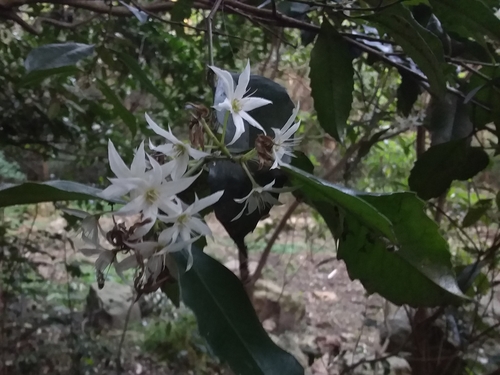
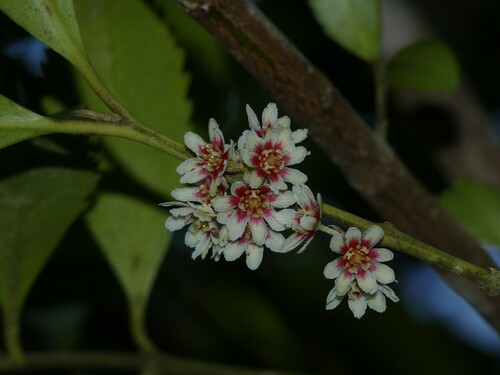
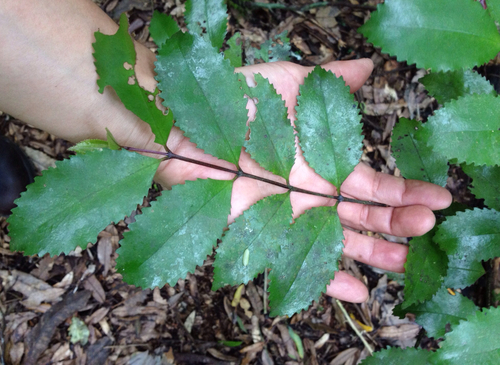
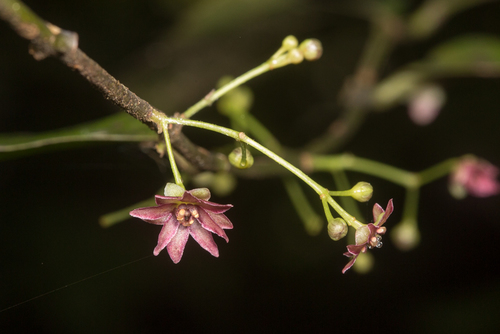
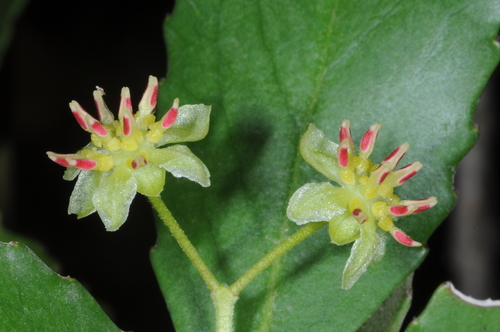
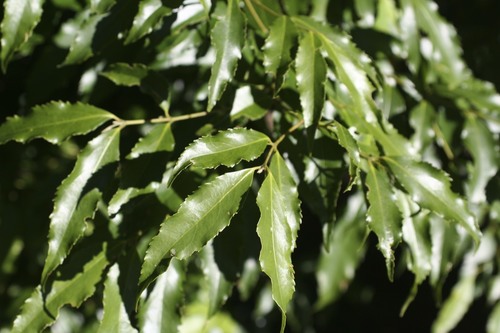
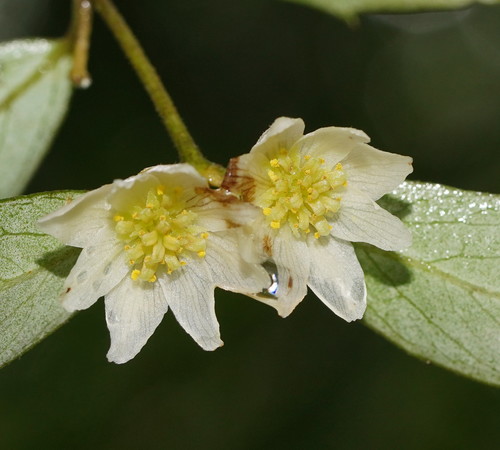
Atherosperma moschatum Labill., commonly called black sassafras, is a plant that ranges from a shrub to a conical tree, typically growing between 2 and 30 metres (7 to 100 feet) tall. Its young branchlets, flowers, and the lower surface of leaves are usually densely covered in hair. When crushed, the leaves of this species give off a nutmeg scent. Leaves are lance-shaped (sometimes with the narrower end at the base) or elliptic, measuring 30–95 mm (1.2–3.7 in) long and 8–23 mm (0.3–0.9 in) wide, attached to stems by a 2–6 mm (0.08–0.2 in) long petiole. The upper leaf surface is glossy green, and leaf edges are sometimes irregularly toothed. Flowers of Atherosperma moschatum have a pleasant scent, with cream to white tepals 6–10 mm (0.2–0.4 in) long that are often streaked with purple. The flower receptacle is 10–12 mm (0.4–0.5 in) long and densely hairy. Flowering takes place from July to October, and the fruit is a densely hairy achene 10–20 mm (0.4–0.8 in) long. Black sassafras grows along streams in deep gullies at higher elevations, with confirmed occurrences at Barrington Tops, the upper Blue Mountains, and Tia Gorge in New South Wales, as well as in cool-temperate rainforest in eastern Victoria and eastern Tasmania. It often grows alongside Nothofagus cunninghamii and Elaeocarpus holopetalus. The subspecies Atherosperma moschatum subsp. integrifolium is restricted to cool-temperate rainforest in the Barrington Tops and Blue Mountains. This smooth-barked species does not shed its bark every year, and acts as a rich host for many lichen species. A field study conducted in Errinundra National Park recorded a total of 54 lichen species growing on A. moschatum, with 11 lichen species found on trees of all measured sizes. The most commonly recorded lichen species on this tree was Pannaria microphyllizans. The rainforest pockets where A. moschatum grows are thought to be critical refuges for lichen populations within fire-prone eucalyptus woodland. For cultivation, A. moschatum requires consistent moisture and shade, so it is not commonly cultivated. It has been planted in the British Isles as far north as Northern Ireland and Scotland. The leaves have a distinct scent, and may be chewed to release a noticeable flavour and tingling sensation. However, the safety of consuming this plant is not confirmed, and it may be poisonous.