About Atheniella flavoalba (Fr.) Redhead, Moncalvo, Vilgalys, Desjardin & B.A.Perry
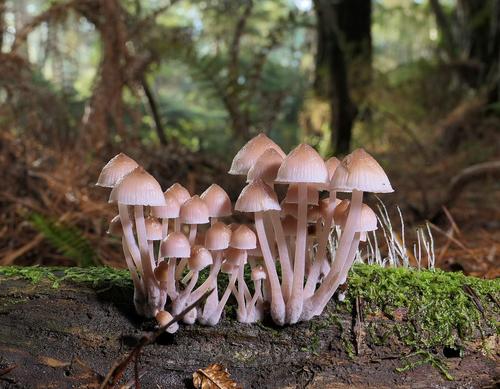
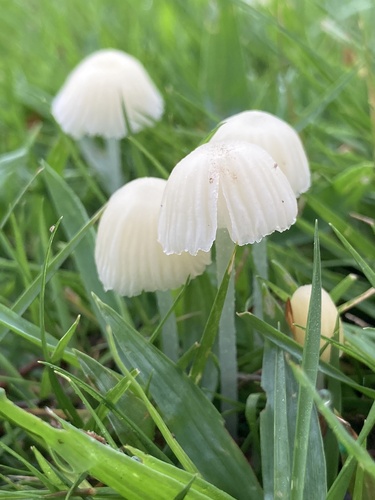
The cap of Atheniella flavoalba is 1–2 cm (0.4–0.8 in) in diameter. It is conical when young, and matures to become somewhat bell-shaped, broadly conic, or occasionally nearly convex. A papilla, which is a nipple-like structure, may develop in the center of the cap. The cap margin is initially pressed against the stem, and when mature it either flares out or curves slightly inward. The cap surface is smooth, moist, and partially translucent, allowing the outline of the gills underneath the cap to be seen. This mushroom is hygrophanous, meaning it changes color as it gains or loses moisture: it starts out cream-buff to yellowish with an almost white paler margin, and fades to buff in the center and yellowish-white along the margin when dry. The flesh is yellowish to white, thick under the cap disc but thin elsewhere, moderately fragile, and has no distinctive odor or taste. The gills are ascending, and somewhat hooked or toothed. They are narrow at first, growing to become rather broad, reaching 2.5 mm initially and expanding to 3–4 mm. The gills are roughly equal in width throughout, or become slightly ventricose (swollen) as they age, and are spaced from close to subdistant. About 18–24 gills extend all the way to the stem, with two tiers of short lamellulae (gills that do not reach fully from the cap margin to the stem); veins may develop between these gills. The gills are white to creamy-white with even, whitish edges, and have a waxy appearance and consistency. The stem is 3–8 cm (1.2–3.1 in) long, 1–2.5 mm (0.04–0.10 in) thick, equal in width along its length, tubular, somewhat elastic, and cartilaginous, and it is not particularly fragile. The base of the stem is either strigose (covered in sharp, straight, stiff white hairs) or surrounded by matted white mycelium. Above the base, the stem surface is smooth, and it is pruinose (powdery) toward the apex. When moist, the stem is translucent with slight transverse ripples, and it is white to pale yellow. For microscopic characteristics, the spores are 7–9 by 3–4.5 μm, ellipsoid, and nonamyloid. The spore-bearing basidia are four-spored. Pleurocystidia (found on the gill face) and cheilocystidia (found on the gill edge) have similar structure, are abundant, and are ventricose with long, fairly narrow necks. They measure 46–62 by 9–14 μm. The neck is often encrusted with a mucilaginous substance, and is otherwise smooth and hyaline (translucent). The gill flesh is homogeneous, and stains pale yellow in iodine. The cap flesh has a thin, poorly differentiated pellicle (thin outer membrane), a somewhat differentiated hypoderm that is most pronounced in older caps, and the remaining tissue is made up of somewhat enlarged cells that also stain pale yellow in iodine. Fruit bodies of Atheniella flavoalba grow scattered to densely gregarious in mossy pastures, conifer needle beds, or on humus in oak woods during autumn. The species is common in old European grassland. It is less common in North America, though it sometimes grows in large numbers at specific localities. In the United States, it has been collected from Colorado, Idaho, Michigan, North Carolina, Oregon, Washington, Wyoming, Florida, and Kansas. It has also been found in Israel. Atheniella flavoalba is listed as Least Concern in the Danish Red Data Book, and is considered inedible.