About Atheniella adonis (Bull.) Redhead, Moncalvo, Vilgalys, Desjardin & B.A.Perry
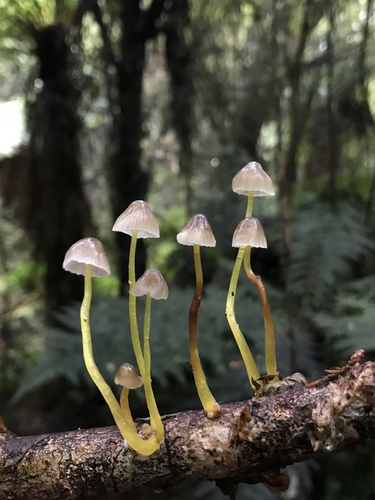
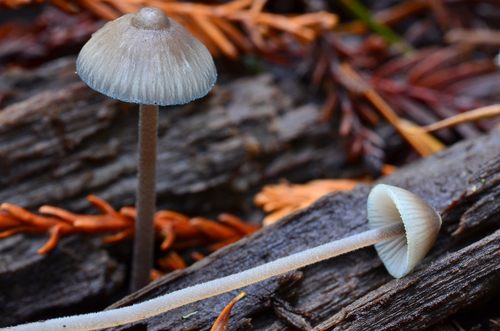
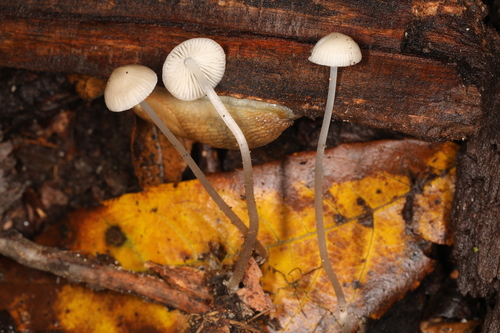
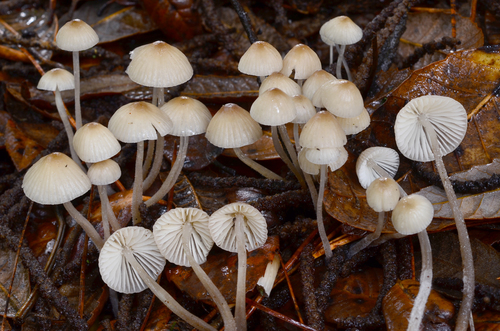
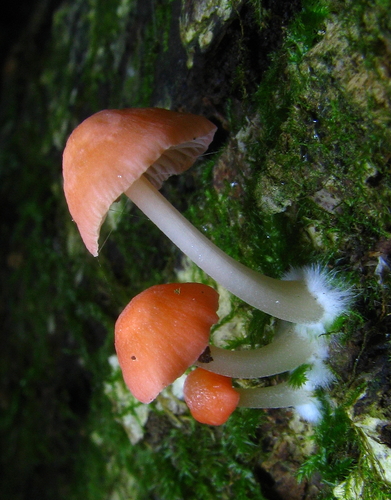
Atheniella adonis (Bull.) Redhead, Moncalvo, Vilgalys, Desjardin & B.A.Perry has a cap that starts out sharply conic, expanding to a narrow bell shape or broad cone when mature. The cap typically reaches 0.5 to 1.2 cm (1⁄4 to 1⁄2 in) in diameter. It is scarlet red when young, fading to orange or yellowish as it ages. The cap margin, which is initially pressed against the stem, is opaque or nearly opaque when young. This mushroom is hygrophanous, fading to orange buff when it dries out. The flesh is thin, matches the cap's color, is fragile, and has no distinctive taste or odor. The gills are ascending-adnate, meaning they attach to the stem at much less than a right angle and appear to curve upward toward the stem, or attach by a small tooth. They are spaced from subdistant to close, with 14–16 full gills that reach the stem, plus two or three tiers of shorter lamellulae that do not extend fully from the cap edge to the stem. The gills are narrow, starting yellowish or with a reddish tinge; their margins are paler and match the color of the gill faces. The stem is 2–4 cm (3⁄4–1+5⁄8 in) long, 1–2 mm (1⁄32–3⁄32 in) thick, and roughly equal in width along its length. It is tubular and fragile, initially covered in a fine powdery coating (pruinose), becoming polished and smooth with age. It is pale yellow at first, fading to whitish, and the base is often dirty yellow or brownish. Microscopically, the spores are narrowly ellipsoid, inamyloid, and measure 6–7 by 3–3.5 μm. The spore-bearing basidia are four-spored, and measure 20–22 by 6–7 μm. Cheilocystidia (on gill edges) and pleurocystidia (on gill faces) are abundant, similar in shape and markings, and measure 40–58 by 10–15 μm. They taper somewhat at both ends and usually have a long needle-shaped neck, which is branched in some individuals. The cystidia are generally smooth, but when dried material is mounted in potassium hydroxide for light microscopy, an amorphous substance traps spores and debris around the neck or apex, making the cystidia appear encrusted. The gill flesh stains very faintly vinaceous-brown when treated with iodine. The cap flesh has a thin, poorly differentiated pellicle, with a layer of slightly enlarged cells beneath it; the rest of the cap flesh is filamentous, and this filamentous portion stains vinaceous-brown in iodine. Fruit bodies of A. adonis grow singly or in groups in conifer forests and heaths, and appear in spring and autumn. They also grow scattered or in groups on needle beds under spruce and hemlock in wet coastal conifer forests, or in higher mountains, where it is not uncommon in spring and autumn. The fungus is found in Europe and western North America; Mycena specialist Alexander H. Smith collected the species in Washington, Oregon, and California. In 2007, it was reported from the Ussuri River valley in northeast China. In one recorded case, fruit bodies were found growing on the bark of deciduous trees Spanish maple (Acer granatense) and white willow (Salix alba) near Amsterdam. Researchers hypothesized that atmospheric pollution from industrial smoke, which increased levels of sulfuric and nitric acid, had made the bark of these trees more acidic, creating a more suitable substrate for the fungus.