About Athallia pyracea (Ach.) Arup, Frödén & Søchting
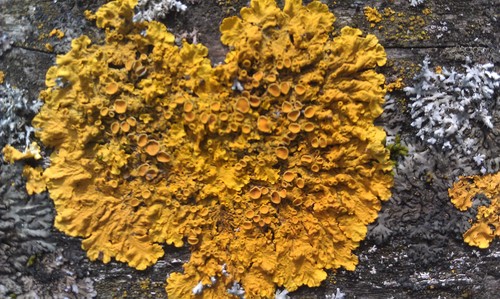
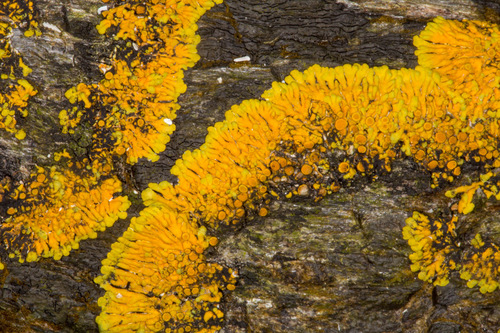
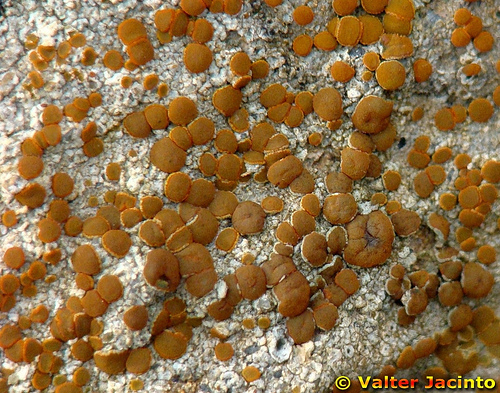
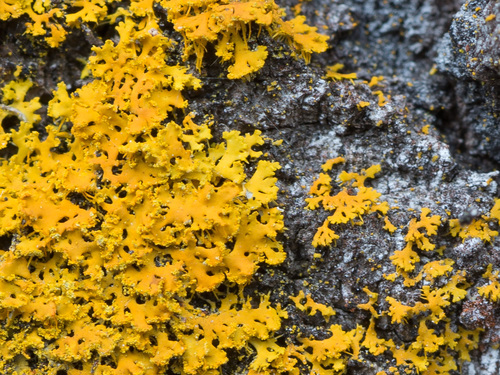
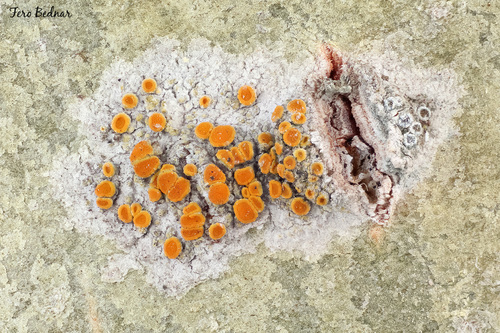
Athallia pyracea forms a very thin, crustose thallus on bark, which is sometimes partly immersed in the bark substrate. The thallus surface is flat to slightly warty, also called verruculose, and often cracked, also called rimose, into small areoles that measure 50–200 μm in diameter. Its colour ranges from pale greyish or greyish yellow to orange-yellow or orange; many thalli have a greyish background with scattered yellow-to-orange spots. A thin, grey prothallus may sometimes be visible at the thallus margins. The cortex is usually weakly developed, and consists of an amorphous layer of indistinct, roughly isodiametric cells. Apothecia are usually abundant, and range from scattered to crowded; they rarely touch, and sit adnate to sessile on the thallus. They are round to somewhat irregular, and typically 0.3–1.0 mm across, with an orange flat to slightly convex disc. A thalline margin is generally present, though it can become excluded in some apothecia. The exciple is usually 35–50 μm thick, and may be slightly raised or level with the disc; the epithecium is orange and granular. Microscopically, the hymenium is colourless and about 70–90 μm thick, with a hyaline hypothecium around 70–100 μm thick that is sometimes infused with oil droplets. Paraphyses are unbranched or branched near their tips, with upper cells swollen to around 4–7 μm in diameter; each ascus contains eight spores. The ascospores are ellipsoid to broadly ellipsoid, typically measuring 10–15.5 × 5.5–8 μm, and are polarilocular, meaning they are two-celled with a thickened septum. The septum is usually 3.8–5.5 μm thick, and often measures about one-third to one-half of the total spore length. The yellow parts of the thallus and the apothecia produce a K+ purple reaction, meaning they turn purple when treated with potassium hydroxide. Athallia pyracea occurs in temperate regions of the Northern Hemisphere, with confirmed records from Europe, North America, and parts of Asia. In Great Britain, it has been recorded across the entire country and is especially frequent in the north, for example in parts of Scotland. This lichen grows predominantly on the bark of nutrient-enriched, base-rich deciduous trees such as aspen, poplars, and ash. It only very rarely colonizes other substrates, with isolated reports of A. pyracea growing on lignum, or dead wood, or even on calcareous rock outcrops. Athallia pyracea is an epiphytic lichen that grows in nitrogen-rich environments, and is classified as a nitrophilous species that prefers nutrient-enriched substrata. In Europe, it often co-occurs with the similar bark-dwelling lichen Athallia cerinelloides in nitrophilous tree-bark communities. Several lichenicolous, or lichen-dwelling, fungi have been documented growing on A. pyracea. The widespread fungus Lichenodiplis lecanorae is known to grow on the apothecia of A. pyracea. The species Trichoconis hafellneri was described in 2016 from specimens collected growing on A. pyracea, as well as on Xanthoria parietina.