About Atalotriccus pilaris (Cabanis, 1847)
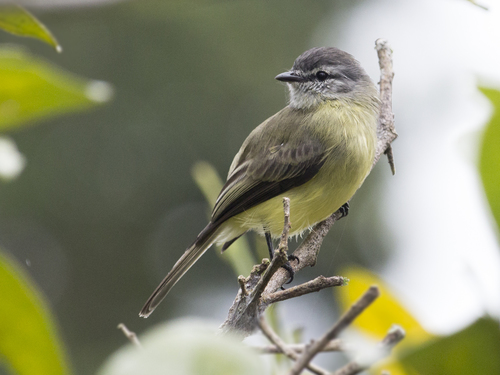
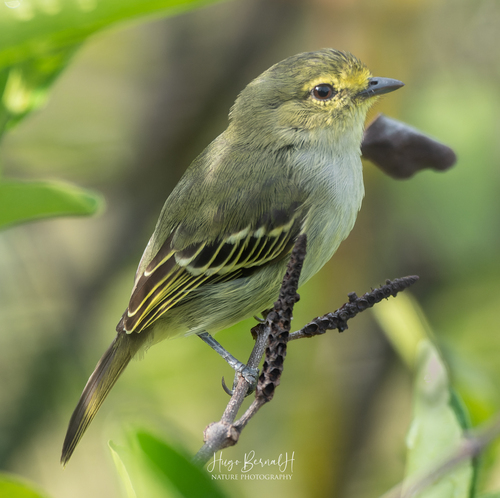
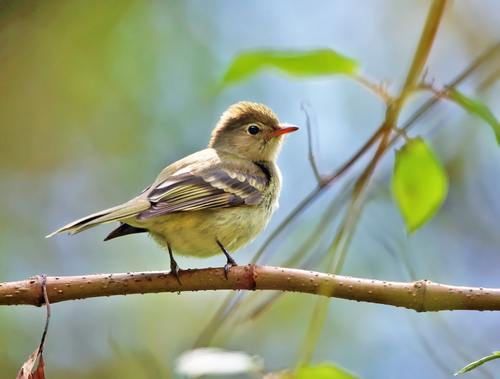
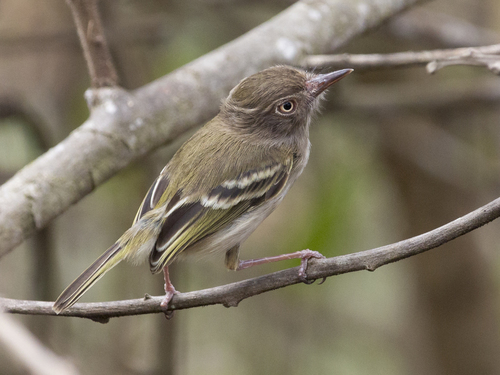
The pale-eyed pygmy tyrant (Atalotriccus pilaris, first described by Cabanis in 1847) measures 8 to 11 cm (3.1 to 4.3 in) long and weighs approximately 6 g (0.21 oz). Males and females have identical plumage. For the nominate subspecies A. p. pilaris, adults have a bright olive crown and nape suffused with gray. Their lores are whitish on the upper half and gray on the lower half, with a pale partial eye-ring and gray ear coverts. The back, rump, and uppertail coverts are bright olive. The wings are dusky, with olive-green edges on the flight feathers and lemon to pale olive tips on the wing coverts; these colored tips form two distinct wing bars. The tail is dusky. The throat and underparts are mostly whitish, with diffuse dusky streaks on the throat and upper breast, and a lemon tinge on the lower flanks and undertail coverts. Compared to the nominate subspecies, A. p. wilcoxi has duller green upperparts, paler yellow underparts, and less distinct wing bars. A. p. venezuelensis has a grayer crown and brighter green upperparts than the nominate. A. p. griseiceps has a smoky gray crown, with a cinnamon buff or rufous tinge on the forehead and around the eyes. All subspecies have a yellowish white iris, a dark brown to black bill that often has a pinkish base, and pale pink to pinkish orange legs and feet. The pale-eyed pygmy tyrant has a disjunct distribution, with each subspecies occupying a separate range. A. p. wilcoxi is found on the Pacific slope of Panama, from Chiriquí Province east to the Canal Zone. A. p. pilaris occurs in northern Colombia, from Bolívar Department south to Huila Department, and extends east into Zulia and northwestern Táchira states in northwestern Venezuela. A. p. venezuelensis lives in northern Venezuela, from Falcón east to Sucre. A. p. griseiceps ranges from Meta Department in east-central Colombia east across northern Amazonas and northern Bolívar states in Venezuela, with a separate small population in western Guyana and adjoining Roraima in northern Brazil. The species inhabits a variety of landscapes, most of which are somewhat dry. Habitats include dry to arid scrublands, open woodland, savanna, moister deciduous and semi-deciduous woodlands, secondary forest, gallery forest, small patches of suburban and urban forest, and shrubby borders of croplands. In coastal Colombia, it can also be found in mangroves for part of the year. Its maximum elevation varies by region: it reaches 900 m (3,000 ft) in Panama, 1,800 m (5,900 ft) in Colombia, 1,700 m (5,600 ft) in far western Venezuela, and only 300 m (1,000 ft) across most of the rest of Venezuela.