About Astroloba rubriflora (L.Bolus) Gideon F.Sm. & J.C.Manning
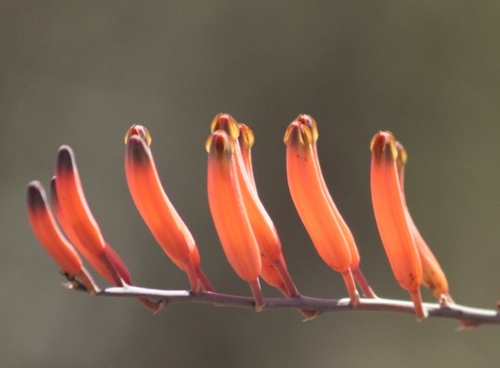
This species is one of the most unusual members of the Astroloba genus. Its flowers differ from those of its close relatives in the Astroloba and Haworthia genera, and more closely resemble the flowers of Aloes. These flowers have evolved to be pollinated by sunbirds. The species produces a long, thin inflorescence with a horizontal raceme, bearing red flowers with green tips; the entire structure twists into an erect position. Flowers appear from December to April. The plant forms multiple sprawling stems that reach up to 45 cm long. These stems are densely covered in sharply pointed, waxy blue-green leaves, which turn brownish when exposed to harsh sun. This species is indigenous to the Robertson Karoo vegetation type of the Western Cape, South Africa. Robertson Karoo is a succulent-rich, semi-arid, winter-rainfall Karoo vegetation type named for the town of Robertson. It occurs naturally in an approximate range between the towns of Robertson, McGregor and Bonnievale. In its native habitat, it typically grows in sheltered positions underneath bushes and shrubs, often on low hills and slopes. It grows in either light shade or full shade, forming clumping caulescent rosettes up to 76 mm (3 inches) across. Its leaves measure 20–41 mm (0.8–1.6 inches) long, 20 mm (0.8 inches) wide, and 5.1 mm (0.2 inches) thick. It is a winter-growing species that can be propagated by either seed or cuttings.