About Astroloba foliolosa (Haw.) Uitewaal
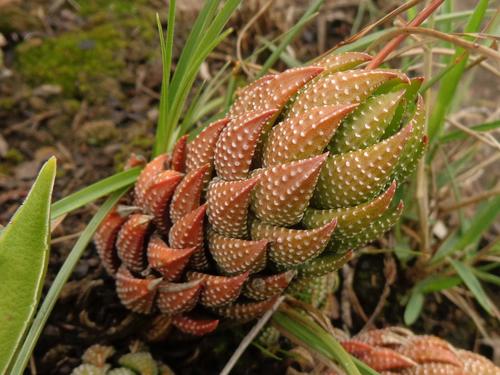
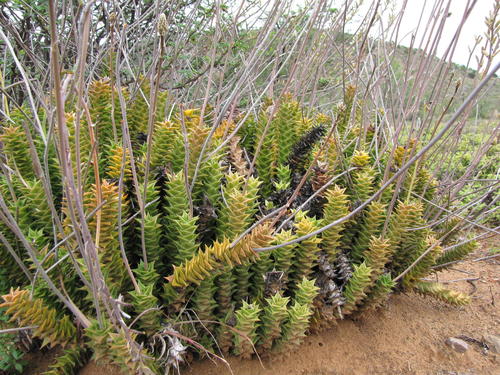
Astroloba foliolosa has slender stems that are 4–5 cm wide. These stems can reach over 20 cm in height and sprawl across the ground. Stems are densely covered in rounded triangular leaves, which are arranged in 5 ranks and sometimes form a loose rough spiral. The leaves are smooth, glossy, and grey-green; they curve outwards, sometimes reaching almost a 90-degree angle relative to the stem. Leaves have distinct keels and margins, and their upper face is flat or convex. This species produces cream-white flowers during the rainy season, which runs from July to March depending on the region. The flowers are tinged with green or yellow, and have unusually short pedicels, a trait it shares with its eastern relative Astroloba congesta. Astroloba congesta differs from A. foliolosa in having wider stems and concave upper leaf faces. A. foliolosa's close western relative Astroloba robusta has no pedicels at all, and bears longer, grey-brown leaves. This species is native to the Karoo flats of Eastern Cape Province, South Africa. Its range extends south from Graaff Reinet towards Albany, and east to Cradock, where A. congesta replaces it. To the west, its range reaches as far as Steytlerville, where it is replaced by A. robusta. The entire distribution area has relatively high annual rainfall, between 250–400 mm, that falls mostly in the summer.