About Astrocaryum standleyanum L.H.Bailey
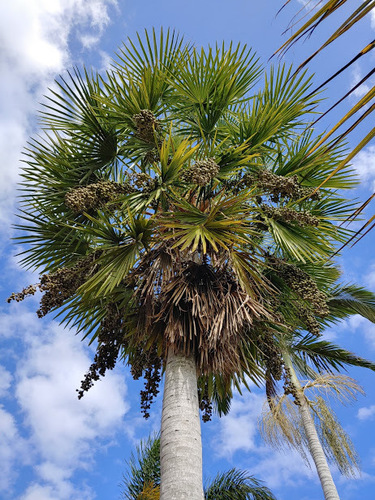
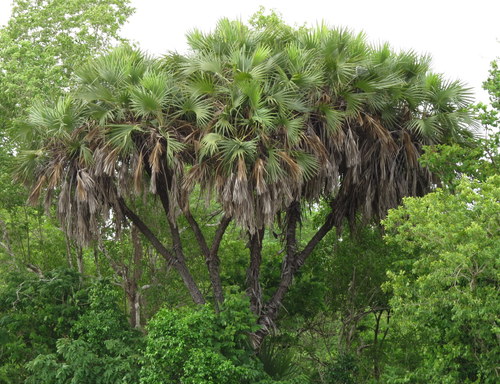
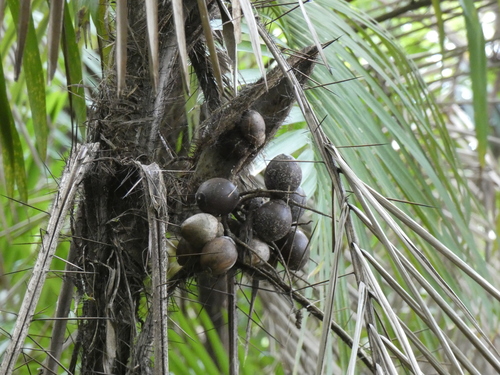
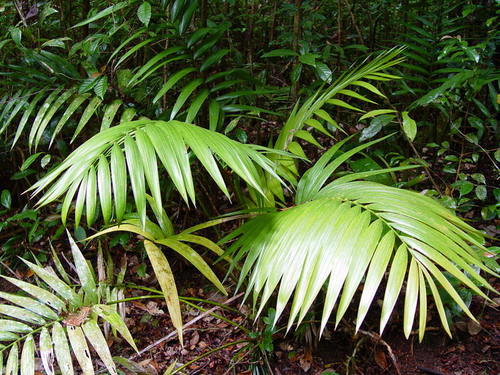
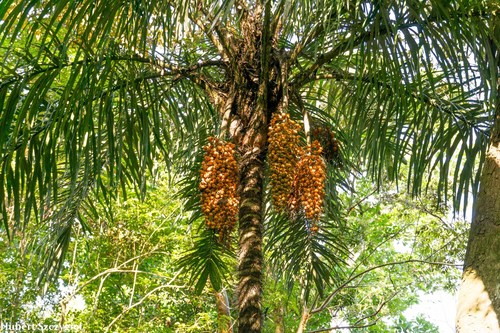
This palm species, Astrocaryum standleyanum, reaches 15 to 20 meters in height, with a trunk diameter of 18 to 25 centimeters. Its trunk is densely covered in sharp, flattened black spines up to 20 centimeters long; smaller spines grow on leaf stalks, leaf edges, and the peduncles that hold fruit clusters. A single plant holds around 15 mature leaves at a time. Its pinnate fronds can grow up to 4 meters long, with a typical palm-like appearance. The many leaflets are arranged irregularly, clustered, and angled, with a glaucous underside. A mature, fully expanded leaf lives for about 4.5 years, and the plant produces 3 to 5 new leaves each year. The trunk is marked with scars from fallen leaves, and spines grow between these leaf scars. The plant reaches reproductive maturity at 9 to 10 years of age. Flowering happens during the rainy season. The inflorescence, which holds tiny white flowers, grows upright at first, then bends and hangs as fruits develop. The fruiting season runs from March through June, and a mature plant produces around 6 fruit clusters in this period. Each cluster is a hanging spadix that holds roughly 500 fruits in optimal conditions, and only around 100 fruits in less favorable conditions. Each fruit holds a seed up to 3 centimeters wide, covered in pulpy orange flesh, and weighs about 25 grams. The fruit is eaten by many animal species, including agoutis, squirrels, spiny rats, capuchins, opossums, pacas, coatis, peccaries, and tapeti rabbits. While capuchins can reach the fruit by jumping from other trees to navigate the spines, most animals collect fallen fruit from the ground. Researchers have suggested that besides modern living species, the fruit was once dispersed by now-extinct large animals such as gomphotheres. All these animals disperse the plant's seeds. The Central American agouti (Dasyprocta punctata) plays a particularly important role in the plant's life cycle. This palm is one of the most important food sources for the Central American agouti; the agouti collects the fruits and caches the seeds by burying them in soil. Agoutis regularly check their caches, often digging up seeds to rebury them in new locations. One agouti will frequently rob another agouti's cache, moving seeds further. Researchers tracking cached seeds observed one seed moved 36 times before being eaten. This scatter-hoarding behavior helps the palm spread across the forest. Since the palm's fruiting season only lasts around four months a year, agoutis rely on cached seeds for much of their diet during the rest of the year. The Central American spiny rat (Proechimys semispinosus) also scatter-hoards the palm's seeds. Other animals, such as ants, do not help the plant, as they destroy seeds while eating the fruit pulp. Most fruits are infested by bruchid beetles, but scolytid beetles are more effective seed predators for this species. This palm most commonly grows in wet forest at elevations up to 500 meters. For humans, the fruit and palm hearts are edible. Other human uses include its wood for walking sticks, bows, and fishing rods. The fruits are used as pig feed, and the plant is sometimes processed for oil. It is a very important fiber plant for many local peoples, including the Wounaa, Emberá, and native groups of African ancestry such as Afro-Colombians and Afro-Ecuadorians. Fibers are harvested from the leaves. Opened leaves produce stronger fibers used for mats, while less sturdy fibers from immature leaves are used for basketry. The fibers are used to make a wide range of items, including furniture, pitchers, plates, trays, coasters, vases, bags, hats, jewelry and accessories, hammocks, and fishing nets. Most often, harvesters cut fronds directly from living trees to collect fiber, but sometimes the whole tree is cut down, which is a more destructive practice. While the species is widespread across its range, it has been decimated in local areas where demand for its fiber is high. Its conservation status remains unknown across most of its range. In parts of Ecuador, the species is maintained through tropical agroforestry practices, with some local people growing plots of the palm alongside their other crops. Harvesters usually collect usable parts with a machete, taking care to avoid the palm's sharp spines. Instead of felling the tree, they may use a media luna — a long pole with a curved blade at the end — to remove leaves, or a bamboo pole fitted with a chisel at the end. The Emberá people prefer to harvest the palm during the full moon, when they believe the fibers are strongest. After splitting a leaf, harvesters extract two types of fiber: a thick fiber suitable for basket frames, and a thinner fiber used for weaving. The fibers are washed and sun-dried, then sometimes dyed with extracts from other plants, bleached with sulfur, or buried in mud to darken them. For basketry, these fibers are sometimes woven together with fibers from the Nahuala palm (Carludovica palmata), a palm-like monocot. Except in Ecuador, few of the handmade products are used locally by the harvesters. Most are sold locally, at nearby markets, or shipped internationally. There is a large global market for handcrafted plant-fiber products, with Japan and the United States as major importers. This species is considered one of the most economically important palms in Ecuador.