About Astrocaryum aculeatum G.Mey.
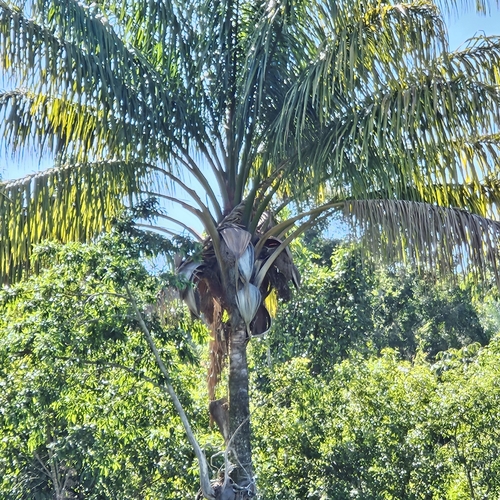
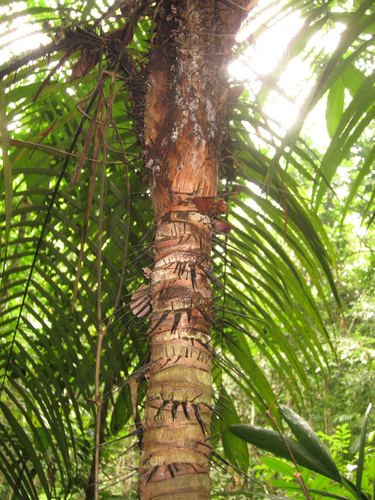
Astrocaryum aculeatum G.Mey. is a palm species known by many common names in Brazilian Portuguese, including tucumã, acaiúra, acuiuru, coco-tucumã, tucum, tucumã-açu, tucumã-macaw, tucum-açu, tucumaí-da-terra-firme, tucumãí-uaçu, tucumã-piririca, tucumã-purupuru, and tucumã-do-mato. This species is native to tropical South America and Trinidad. It typically grows as a solitary individual reaching up to 15 meters (49 feet) tall, with ascending leaves, an erect inflorescence, and yellow fruit. The distribution of Astrocaryum aculeatum centers on and around the Amazon Basin. Its range extends north to Trinidad and Tobago, through Venezuela, Guyana, and Suriname, and includes the Brazilian states of Acre, Amazonas, Pará, Rondônia, and Roraima. Its range continues south through the Bolivian departments of Beni, Pando, and Santa Cruz. This palm has multiple human uses. Its fruit is edible, and can be processed to make a type of juice. It is also used to create a symbolic ring called the tucum ring, which is most commonly used in Catholic churches as a symbol of commitment to social justice, peace building, and ecology. A fiber extracted from the plant's leaves is used to make hammocks and ropes that are resistant to salt water.