About Astrantia minor L.
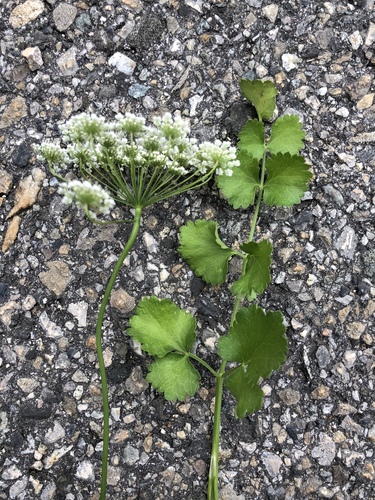
Astrantia minor L. is a flowering plant that typically grows 15–30 cm tall. It has simple stems that are rarely branched in the upper half. Basal leaves come in two forms, often found on a single individual: one type has all narrow, pinnatisect segments, while the other has broad segments, with the central segment being pinnatisect and the lateral segments being deeply pinnatipartite. Leaf petioles measure 4–12 cm long. Leaf blades hold (5) 7 (8) segments that are 1-3 (4.5) cm long and 0.5-1.3 cm wide, are pale green, and have toothed margins along their upper half to two-thirds. The stem section just below the inflorescence is 2 to 3.2 cm long and 0.2-0.5 cm wide, and its leaves are reduced to 3-5 segments.
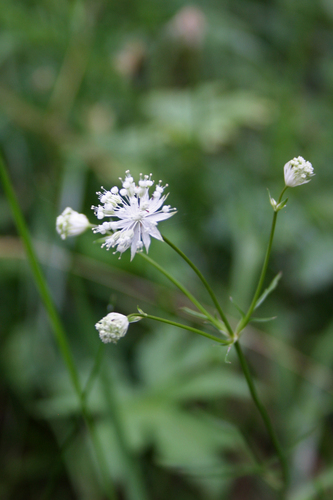
The inflorescence holds 1-3 unequal peduncles: the central peduncle is sometimes branched, and longer than the side peduncles which each bear a single umbel. Umbels are surrounded by (10) 12-14 bracts that measure 4-10 mm long and 1–3 mm wide. These bracts are membranous, have entire margins, and have a green apex with three ribs. Each umbel holds 30-40 flowers, which are the same length as or slightly shorter than the surrounding bracts. Flowers are generally hermaphroditic in the center of the umbel, and male on the periphery. Calyx teeth are roughly 1 mm long, shaped ovate-oblong, subobtuse, and slightly bearded; they are 1.5-2 times longer than they are wide. Petals are similar in size to the sepals, and colored white or cream. Stamens extend beyond the petals. Fruits are ovoid, measure (1.5) 2–5 mm, bear vesicle-shaped scales, and have a subobtuse apex.
Flowering occurs in summer, from July to August, and fruiting takes place between August and September. This species differs from its close relative Astrantia major in its smaller overall size, its seven-segmented basal leaves (instead of five), and its obtuse, slightly mucronate calyx teeth.
Its habitat occurs in clumps of large plants near streams, and in clearings within mountain azalea (Rhododendron ferrugineum) scrub, growing on fresh alpine and subalpine soil. It prefers a pure salicaceous substrate, and grows at elevations between (1850) 2100 and 2300 (2600) meters. It is endemic to central and southern Europe, found in France, Switzerland, Italy, and Spain. On the Iberian Peninsula, it occurs only in the Pyrenees, in Catalan lands and Huesca; it is found in the extreme southwest of this region in Valle de Benasque.