About Astrantia major L.
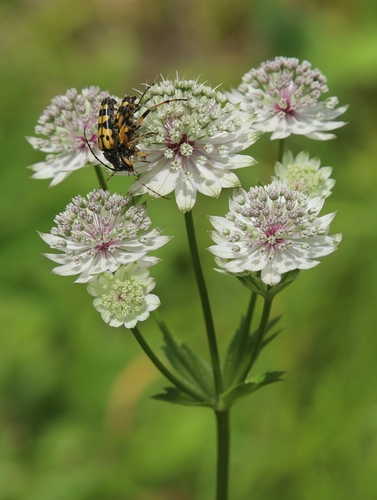
Astrantia major L. reaches an average height of 60 centimetres (24 in). Its stem is erect, glabrous, and has few branches and few leaves. Basal leaves have long petioles 10–20 centimetres (3.9–7.9 in) long, with 3 to 7 lobes and toothed segments, and measure 8–15 centimetres (3.1–5.9 in) across. There are generally two cauline leaves, which are sessile, amplexicaul, lanceolate-shaped, and have a trilobed apex. The inflorescence is umbrella-shaped, with a diameter of 2–3 centimetres (0.79–1.18 in). The plant has 10 to 20 numerous floral bracts 10–18 millimetres (0.39–0.71 in) long, that are reddish (sometimes white) with an acuminate apex. Its small flowers are greenish-white with reddish shades. Central flowers are hermaphrodite, while outer flowers are male. It has five petals, which are white or slightly reddened, and five stamens that are much longer. Individual flowers are about 1 mm across. The flowering period extends from June through September. This plant is native to southern Europe (the Pyrenees, Carpathians and Balkans), and also occurs from the Caucasus up to Anatolia. It is found in Albania, Austria, Belarus, Bulgaria, Czechoslovakia, France, Germany, Greece, Hungary, Italy, North Caucasus, Poland, Romania, Spain, Switzerland, Ukraine and Yugoslavia. It has been present in the British Isles since the 16th century, and has naturalized in Shropshire near Stokesay Castle, and in Worcestershire. It is common in mountain meadows, grasslands, forests and clearings, and near streams, usually growing on calcareous soils, at an elevation of 100–2,300 metres (330–7,550 ft) above sea level. Astrantia major is an entomophilous perennial plant, mainly pollinated by beetles, and also pollinated by other insects. It also reproduces via buds present at ground level. Many strains of Astrantia major grow well in gardens when given some shade and moisture. Their flowerheads provide summer color in shades of red, pink and white. The cultivars A. major 'Roma' and 'Sunningdale Variegated' have gained the Royal Horticultural Society's Award of Garden Merit. Additional unlisted cultivars also exist.