About Astragalus purshii Douglas ex G.Don
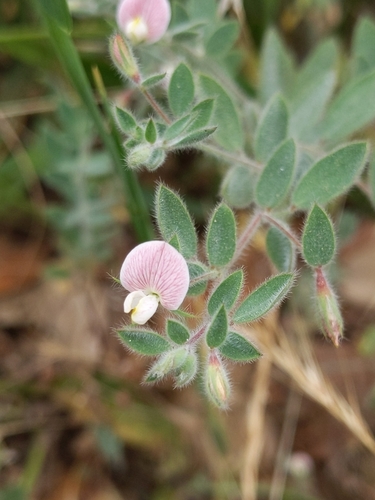
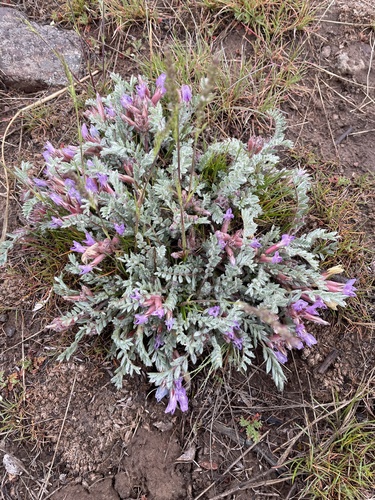
Astragalus purshii is a small perennial herb that grows in low, ground-hugging mats, reaching no more than 14 centimeters tall, and often measuring less than 5 centimeters in height. Its compound leaves can grow up to 15 centimeters long, and are composed of many oppositely arranged pairs of oval or rounded leaflets. Stems and leaflets are covered in woolly white hairs that give the plant's foliage a silvery color. The inflorescence is a cluster holding 1 to 11 complexly shaped flowers that can be pink, rose, purple, or white, with flower color varying by geographic location; each individual flower measures between 1 and 3 centimeters long. The flower bract is covered in long, silky white hairs. The fruit is a legume pod up to 3 centimeters long, densely coated in thick white woolly hairs, that resembles a small rabbit's foot or cottonball. This plant is native to large parts of western North America, including the southwestern provinces of Canada, the northwestern United States, Nevada, and the entire state of California. It grows in many different habitat types, including mountains and deserts. It is common along the Columbia River in arid shrub-steppe habitat, where it grows in shallow soils. It is a serial species that prefers disturbed rocky soils. Astragalus purshii is cultivated as an ornamental plant. As a serial ephemeral species, it is an excellent plant for rock gardens, and it is also added to sustainable landscape and restoration projects managed by municipalities and public agencies. It is also used as a component in reclamation projects. Its seeds do not require stratification, and the plant is tolerant of low precipitation and drought, making it a good candidate for municipal landscaping designed to reduce water usage. Plants are hardy to temperatures as low as −33 °F.