About Astragalus canadensis L.
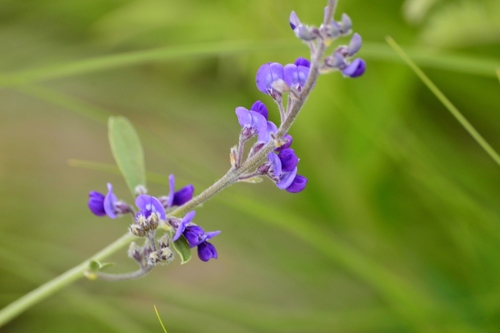
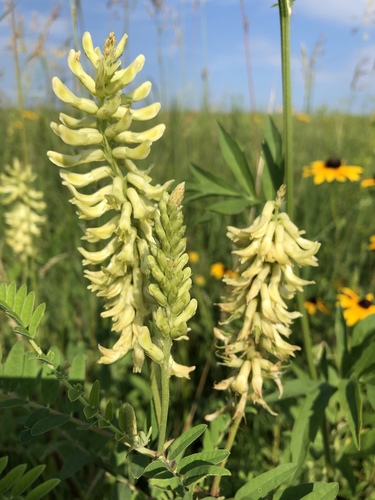
Astragalus canadensis L. is a perennial plant that grows from a taproot and produces several thin, erect, green stems. Stems can reach up to 1.20 meters in height. Its leaves are alternate and pinnate, with elliptic leaflets that grow up to 3 cm long. Between May and July, it produces inflorescences of tubular, greenish-white flowers. After flowering, it develops bean-like seed pods; when the seeds inside dry out, the pods rattle when shaken.
In the wild, Astragalus canadensis typically grows in moist prairies, open woodlands, roadsides, thickets, and streambanks across most of the United States and parts of Canada, where it often forms colonies. Most observations of the species (81%) occur in the US, while 9.8% occur in Canada. It has a global conservation rank of G5, meaning the species is globally secure, and is found across most of the US and Canada, absent from parts of the eastern, southern, and northern regions of these countries. It has various regional conservation ranks: it is ranked S5 (secure) in British Columbia, Montana, Manitoba, and Iowa; S4 (apparently secure) in Alberta, Saskatchewan, Ontario, Indiana, West Virginia, and Virginia; S3 (vulnerable) in the Northwest Territories, Wyoming, Colorado, Louisiana, New York, and North Carolina; S2 (endangered) in Utah, Ohio, and Vermont; and S1 (very endangered) in Michigan, Alabama, Georgia, Pennsylvania, and Maryland. The species is considered extinct in Washington D.C., and many US states do not have an assigned local conservation rank for it. Most observations of the species are recorded in June, July, and August.
Ecologically, Astragalus canadensis acts as a food source for the small weevil Acanthoscelides aureolus. Bumblebees, honeybees, and other bee species collect nectar from this plant. Unlike many other species in the genus Astragalus, its leaves are eaten by deer, rabbits, and groundhogs. This milkvetch also serves as a host plant for Colias alexandra.
Like other species in the Astragalus genus, A. canadensis is somewhat toxic. Despite this, it has been used medicinally by Native American groups including the Blackfoot and Lakota peoples, with the root being the part most commonly used. Its roots were eaten raw, boiled, or used in broth, and were typically gathered in spring and fall.