About Astragalus brauntonii Parish
Scientific Name and Growth Form
Braunton's milkvetch, known scientifically as Astragalus brauntonii Parish, is a large perennial herb that grows from a woody caudex and can reach up to 1.5 meters (4.9 feet) tall.
Stem Characteristics
Its thick hollow stems are covered in coarse white hairs.
Leaf Structure
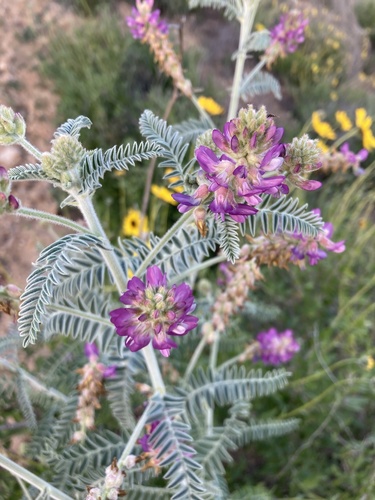
Leaves grow up to 16 centimeters (6.3 inches) long and are composed of many pairs of oval-shaped leaflets.
Inflorescence and Flower Color
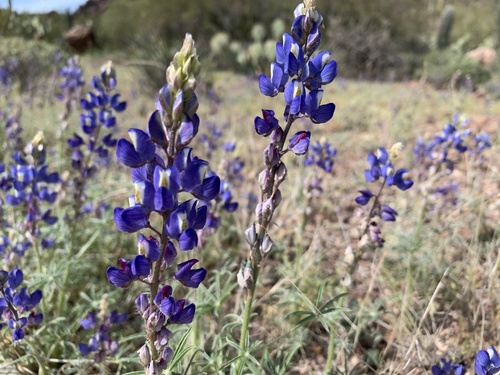
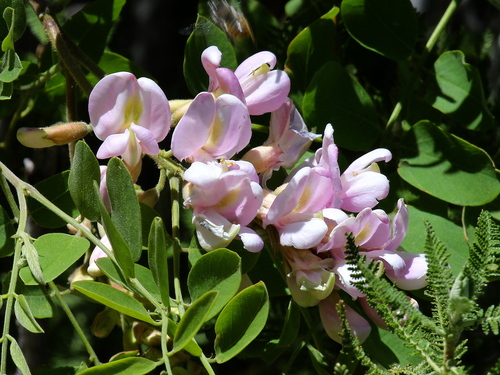
The inflorescence is a dense spike holding up to 60 bright lilac flowers.
Individual Flower Features
Each pealike flower is roughly one centimeter long, with a reflexed hood.
Post-Flowering Trait
After withering, the flowers turn brown but stay attached to the plant instead of falling off.
Pollinators
This plant is pollinated by native Megachile bees and native bumble bees of the genus Bombus.
Fruit Characteristics
Its fruit is a small, bent legume pod.
Habitat Plant Communities
Astragalus brauntonii grows in coastal prairie grasslands, coastal sage scrub, and chaparral plant communities.
Substrate and Disturbance Preference
It is often found in disturbed areas, particularly those with carbonate soils.
California Distribution
There are 16 known remaining populations in California, located in the southwestern Transverse Ranges (eastern Santa Monica Mountains, east end of the Simi Hills, south base of the San Gabriel Mountains) and northern Peninsular Ranges (northwest side of the Santa Ana Mountains), within Los Angeles, Orange, and Ventura Counties.
Baja California Disjunct Population
A disjunct population (variety lativexillum) grows in the coastal hills between Tijuana and Rosarito, in extreme northwest Baja California, almost 240 kilometers south of the southernmost populations of var. brauntonii.
Sympatric Species
It grows sympatrically with Astragalus tijuanensis.
Reproductive Disturbance Dependence
Astragalus brauntonii is an opportunistic species that depends on disturbance, primarily natural wildfire, to reproduce.
Post-Fire Regrowth Strategy
Unlike other fire-adapted perennials in chaparral, it does not resprout from underground vegetative structures.
Seedbank Trait
Instead, it relies on a long-lived dormant seedbank, a trait it shares with another rare perennial legume, Thermopsis macrophylla.
Seed Germination Requirement
The beanlike seeds need scarification from fire or mechanical disturbance to break down their tough seed coats before they can germinate.
Seed Persistence and Population Emergence
Seeds persist for years in the soil until fire or disturbance allows sprouting, so populations of the plant often spring up in areas that have recently burned.
Primary Threat
Alteration of natural fire regimes is a major threat to the species.
Historical Fire Interval
Historically, natural fires in Southern California occurred at intervals of 50 to 100 years.
Current Fire Frequency
Despite modern fire suppression, the current fire frequency is substantially higher, at 15 years or less.
Urban Wildland Fire Risk
Wildlands near urban areas face more frequent fires and ignition sources.
Fire-Related Vegetation Conversion
This converts native woody perennial vegetation to landscapes dominated by invasive non-native annual grasses and forbs.
Non-Native Grass Fire Cycle Impact
These non-native grasslands change the fire cycle further, as they ignite easily and burn more quickly.
Short Fire Cycle Seedbank Impact
Shortened fire cycles reduce the species' seedbank, because mature plants die before they can produce large numbers of seeds.
Non-Native Species Competition
Non-native annuals then outcompete A. brauntonii, reduce its critical habitat, and cause additional alteration of the fire cycle.