About Astraeus hygrometricus (Pers.) Morgan
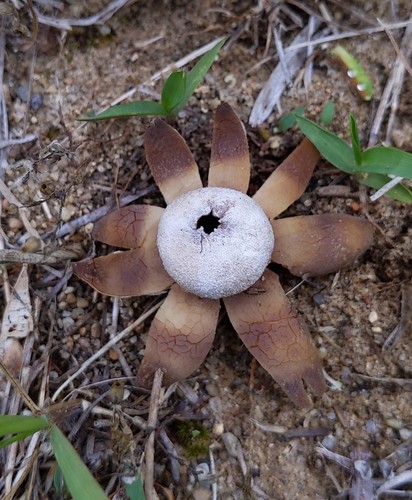
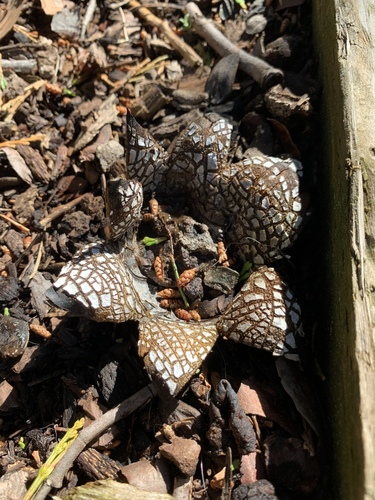
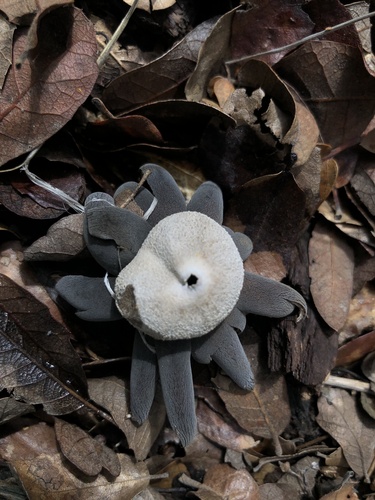
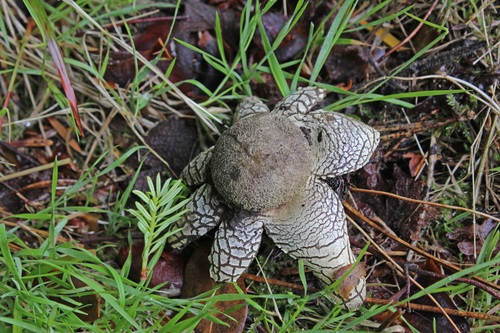
Young fruit bodies of Astraeus hygrometricus are roughly spherical, and typically begin development partially embedded in the growing substrate. A smooth, whitish mycelial layer covers the young fruit body, and this layer may be partially encrusted with debris. As the fruit body matures, the mycelial layer tears away. The outer tissue layer, called the exoperidium, breaks open in a star-shaped (stellate) pattern to form 4 to 20 irregular "rays". This process simultaneously pushes the fruit body above ground, revealing a round spore case enclosed in a thin, papery inner tissue layer called the endoperidium. The rays open and close in response to environmental moisture levels: they open in high humidity, and close when the air is dry. This movement is possible because the exoperidium is made of several different tissue layers; the innermost, fibrous layer is hygroscopic, and curls or uncurls the entire ray as it loses or gains moisture from its surroundings. This adaptation allows the fruit body to disperse spores when moisture conditions are optimal, and reduces evaporation during dry periods. Additionally, dry fruit bodies with curled rays can be easily blown about by wind, allowing them to scatter spores from the pore as they roll. When fully expanded, the fruit body measures 1 to 8 cm (0.5 to 3 in) in diameter from tip to tip. The exoperidium is thick; the upper surfaces of the rays are typically areolate (divided into small areas by cracks and crevices), and dark grey to black. The spore case is sessile (lacks a stalk), is light gray to tan in color, 1 to 3 cm (0.4 to 1.2 in) broad, and has a felt-like or scurfy surface (coated with a loose scaly crust). The top of the spore case opens via an irregular slit, tear or pore. When young, the internal spore-bearing tissue (the gleba) is white and solid, and divided into oval locules – this characteristic helps distinguish A. hygrometricus from the similar genus Geastrum. As the specimen matures, the gleba turns brown and becomes powdery. Small, dark hairlike threads called rhizomorphs extend from the base of the fruit body into the substrate. The rhizomorphs are fragile, and often break off after the fruit body reaches maturity. The spores are spherical or nearly spherical, reddish-brown, thick-walled, and verrucose (covered with warts and spines). They measure 7 to 11 μm across, and their warts are about 1 μm long. The spores are non-amyloid, meaning they will not stain with iodine from Melzer's reagent. Scanning electron microscopy has shown that the spines on the spores are 0.90 to 1.45 μm long, rounded at the tip, narrow, tapered, and sometimes joined at the top. Capillitia, which are masses of thread-like sterile fibers dispersed among the spores, are branched, 3.5 to 6.5 μm in diameter, and hyaline (translucent). The spore-bearing cells, called basidia, produce four to eight spores each, and have very short sterigmata. The basidia are arranged in long strings of clusters; individual basidia measure 11 to 15 μm by 18 to 24 μm. Capillitium threads arise from the inner surface of the peridium; they are thick-walled, long, interwoven, and branched, measuring 3 to 5.5 μm thick. The exoperidium (the outer tissue layer that forms the rays) is made of four distinct tissue layers. The mycelial layer contains branched hyphae 4 to 6 μm in diameter; hyphae in the fibrous layer are branched and 6 to 8 μm in diameter; the collenchyma-type layer has branched hyphae 3 to 4 μm in diameter; the soft layer contains hyphae 3 to 6 μm in diameter. Astraeus hygrometricus is an ectomycorrhizal fungus, and grows in mutualistic association with a broad range of tree species. The association between tree roots and the fungus's mycelium helps trees extract nutrients (particularly phosphorus) from the soil; in exchange, the fungus receives carbohydrates produced by the tree via photosynthesis. In North America, it most commonly associates with oak and pine trees, while in India it is commonly found growing with chir pine (Pinus roxburghii) and sal (Shorea robusta). Commonly called the false earthstar, this species grows on the ground in open fields, often scattered or in groups, and especially favors nutrient-poor, sandy or loamy soils. It has also been reported growing on rocks, preferring acid substrates such as slate and granite, and avoids substrates rich in lime. In Nepal, fruit bodies have been collected at elevations of 3,000 m (9,800 ft). Fruit bodies typically appear in autumn, though dry fruit bodies are persistent and may last for up to several years. Gelatinipulvinella astraeicola is a leotiaceous fungus that produces tiny, gelatinous, cushion-shaped (pulvinate) apothecia. It is known to grow only on the inner surface of the rays of dead Astraeus species, including A. hygrometricus. The genus Astraeus has a cosmopolitan distribution, excluding arctic, alpine and cold temperate regions; it is common in temperate and tropical regions worldwide. It has been collected in Africa, Asia, Australia, Europe, North America, and South America.