About Asterocampa celtis (Boisduval & Le Conte, 1833)
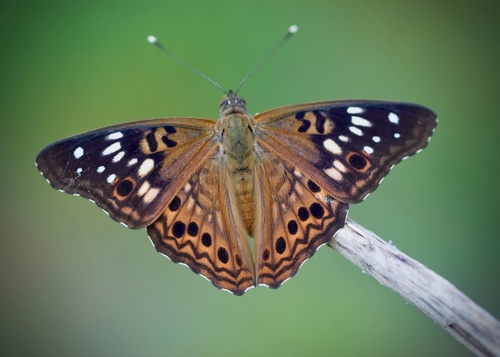
Asterocampa celtis, commonly called the hackberry emperor, is a North American butterfly in the brush-footed butterfly family Nymphalidae. It gets its common name from the hackberry tree – species in the genus Celtis, including Celtis occidentalis – which it uses as its only host plant, laying its eggs on the tree and providing a food source for hatching larvae. The hackberry emperor is known for being a quick, unpredictable butterfly. While it occupies a broad range of habitats, it is most often found along water sources and in lowlands. A notable unusual trait for a butterfly is that this species is rarely seen visiting flowers. Species in the genus Asterocampa are considered "cheater" organisms, because they do not pollinate flowers when they feed on them. More specifically, this species can be described as parasitizing its plant food sources, as it extracts nutrients without providing any benefit to the host plants. As a member of Nymphalidae, the hackberry emperor lays its eggs in clutches, or clusters, on hackberry leaves. There are several plausible evolutionary explanations for this egg-laying behavior, but the exact cause of this behavior is still debated. One possible explanation is that this behavior supports higher fecundity, which may be aided by aposematic coloration. The hackberry emperor has a wide distribution across North America. It has been recorded as far south as central Mexico and as far north as parts of Eastern Canada. Its range extends southwest into Arizona, New Mexico, and other regions of the Rocky Mountains. It is commonly found across the American Midwest, and especially along the East Coast from Florida up to New England. The hackberry emperor lives anywhere that hackberry trees grow. It does not show a preference for any particular species of hackberry. More specifically, this butterfly can be found in cities, forests, and wooded areas, and it especially prefers locations near rivers or other bodies of water. It is not strongly affected by human development. It may also be seen along woodland edges, near creeks, around buildings, and around damp, muddy areas.