About Aster tataricus L.fil.
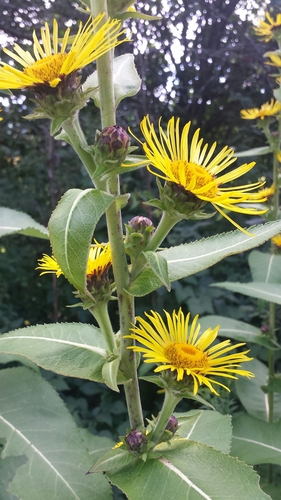
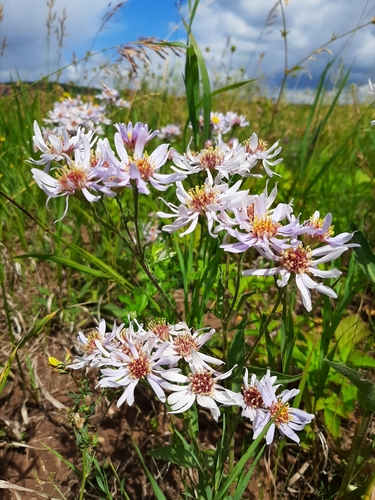
Aster tataricus L.fil. is a perennial plant that typically grows up to 2 meters tall and spreads to a width of up to 1.2 meters. Its stem is scabrous, and it is barely twice as long as the leaves that grow directly from the plant's base; the stem bears few narrower leaves. The radical (basal) leaves are lanceolate-ovate, with deep serrations that are absent only from the leaf apex and leaf base, and they often run down into the petiole. Each inflorescence holds between five and eight proportionally large flowers. The inflorescence's peduncle has two thin, alternate bracts. The calyx has an imbricate arrangement, with a slight purplish tint at the apex of each sepal. The ray flowers are large and blue in color. This species is native to Asia, where it occurs across a range from South Siberia to China to Japan. It has also been introduced to Germany and multiple states in the Eastern United States, specifically Wisconsin, Michigan, Iowa, Alabama and Georgia. Aster tataricus is counted among the 50 fundamental herbs of traditional Chinese medicine, where it is known as zǐwǎn (Chinese: 紫菀). It has antibacterial activity, and inhibits the growth of Staphylococcus aureus, E. coli, Shigella dysenteriae, B. typhi, Pseudomonas and Vibrio proteus.