About Aster amellus L.
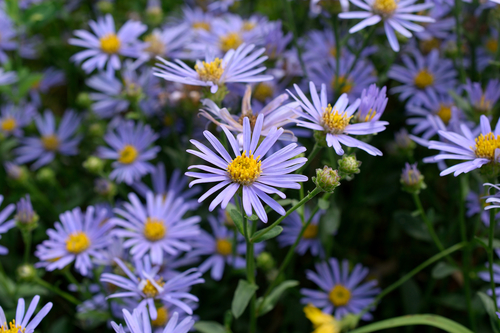
Aster amellus L. grows to an average height of 20–50 centimetres (7.9–19.7 in). It has an erect, branched stem and dark green leaves. Basal leaves are obovate with petioles, while cauline leaves are alternate, sessile, increasingly narrow, and lanceolate. Its flowers are lilac, with a flowering period running from July to October. The hermaphroditic flowers reproduce either via self-fertilization (autogamy) or insect pollination (entomogamy). Its seeds are achenes that ripen in October. This species is found in European mountain ranges, extending from the Pyrenees and Alps to the Carpathians. Outside of Europe, it occurs in western Asia (Turkey), the Caucasus, Siberia, South Asia (Uttarakhand, India), and Central Asia (Kazakhstan). Its typical habitat includes rocky lime-containing areas, the edges of bushes and copses, as well as sub-alpine meadows, marshy areas, and lake shores. It grows best on calcareous, slightly dry substrates with basic pH and low nutrient content, at altitudes between 0 and 800 metres (0–2,625 ft) above sea level. Asters are valued in gardens for producing blue, pink, and white color from late summer through autumn. This species has multiple ornamental cultivars developed for garden use. The following cultivars have received the Royal Horticultural Society's Award of Garden Merit: 'Framfieldii', 'Jacqueline Genebrier', 'King George', 'Veilchenkönigin', and Aster × frikartii 'Mönch'.