About Aspropaxillus giganteus (Sowerby) Kühner & Maire
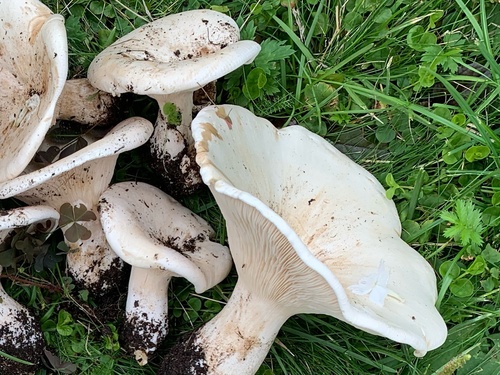
The cap of Aspropaxillus giganteus can grow quite large, with a diameter ranging from 10–50 cm (3.9–19.7 in), and rarely reaching up to 70 cm (28 in). At half its radius, the cap has a thickness of 1 to 1.4 cm (0.4 to 0.6 in). When young, the cap is convex with an inrolled margin; as it matures, it flattens out and develops a shallow funnel shape. The cap surface is smooth and creamy white, but older specimens may develop brown stains and circular cracks. The narrow, closely crowded gills are cream-colored and have a decurrent attachment, meaning they run down the length of the stem; with age, the gills darken to a buff color. The mature stem is off-white with reddish-brown fibers, measuring 3 to 10 cm (1.2 to 3.9 in) tall and 2 to 5 cm (0.8 to 2.0 in) thick. There is no ring on the stem. A dense, white mycelium that may form a mat is typically present at the base of the stem. The flesh is firm and white. Mature specimens are fragile, and hard to remove from the ground without breaking. For microscopic characteristics: when spores are viewed in deposit (such as in a spore print), they appear white. When viewed under a light microscope, the spores are ovoid to ellipsoid, translucent (hyaline), smooth-surfaced, and have broadly rounded apexes and bases; spore dimensions are 6–8 by 3.5–5 μm. The spores of A. giganteus are amyloid, which means they absorb iodine when stained with Melzer's reagent, though the extent of staining can vary. The spore-bearing cells, called basidia, measure 25–40 by 4.5–8 μm, are narrowly club-shaped, and each holds either 2 or 4 spores. The hyphae of this species always have clamp connections. For habitat and distribution: Aspropaxillus giganteus can form fairy rings in grassy areas such as pastures, and is also found along roadsides. It produces fruiting bodies in summer and autumn. It is a saprobic species, meaning it gets nutrients by decomposing organic matter. This fungus has a cosmopolitan distribution, and occurs throughout the temperate zone of the northern hemisphere. It has been recorded in North America, Britain, and Europe. David Arora reports that in North America, it is most common in the Pacific Northwest and the Rocky Mountains.