About Asplenium bradleyi D.C.Eaton
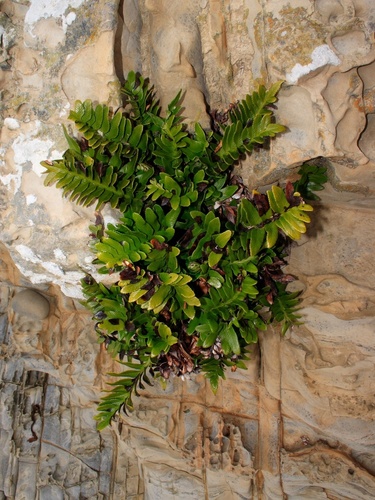
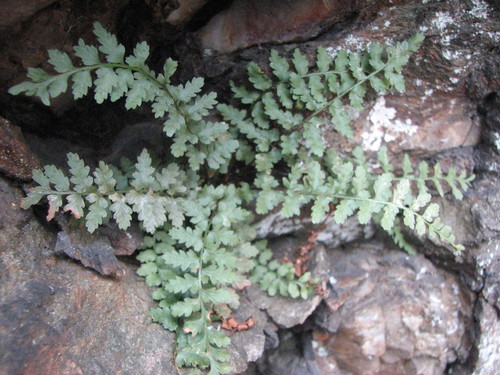
Asplenium bradleyi D.C.Eaton, commonly called Bradley's spleenwort, is a small evergreen perennial fern that grows in tufts. Its fronds are dark green, ranging from pinnate-pinnatifid to bipinnate in structure, and it is monomorphic, meaning sterile and fertile fronds are the same size and shape. Key identifying features of this species include a dark stem whose color extends well up the leaf blade axis, a deeply cut acroscopic lobe or pinnule at the base of each pinna, and toothed pinna edges. However, some of these characteristics are variable across individuals: some specimens have rounded rather than toothed pinna edges, while others lack dark color through most of the stem. Its rhizomes, which are underground stems, are short, grow parallel to the ground or sometimes curve upward, producing clustered fronds. The rhizome is approximately 1 millimeter in diameter, covered in narrowly triangular dark reddish to brown scales that are strongly clathrate, with a visible lattice-like pattern. These scales are 3 to 5 millimeters long and 0.2 to 0.4 millimeters wide, with untoothed or shallowly toothed edges. The stipe, the leaf stalk below the blade, is upright, 1 to 10 centimeters long, occasionally reaching up to 13 centimeters. It is wingless, shiny, and colored reddish- to purplish-brown, and is between one-third and three-quarters the length of the leaf blade. Small brown scales at the base of the stipe transition to hairs closer to the leaf tip. The overall shape of the leaf blade ranges from oblong, with consistent width and tapered ends, to lanceolate, slightly wider just above the base and tapering to a point at the apex. The blade has a squared base and tapered tip, and measures 2 to 17 centimeters long, rarely up to 20 centimeters, and 1 to 6 centimeters wide, with a texture that can be thin or somewhat thick. The blade is divided into 5 to 15 pairs of pinnae, with unusual specimens ranging from 3 to 20 pairs. The pinnae themselves are either deeply lobed or further divided into pinnules. Lower pinnae are stalked, while upper pinnae are stalkless. Pinna shape is variable, but typically has a squared-off or very broadly curved base, and is usually widest at or near the base. The acroscopic lobe or pinnule closest to the rachis on the apical side of each pinna is usually enlarged, and pinna edges are toothed. At the middle of the frond, pinnae measure 6 to 40 millimeters long and 3 to 10 millimeters wide. Fertile pinnae bear three or more pairs of sori, which are 1 to 2 millimeters long, colored rusty to dark brown, and positioned between the pinna margin and midvein. Sori are covered by opaque, untoothed, membranous indusia that range from white to light tan. Each sporangium holds 64 spores. The sporophyte of this species has a chromosome number of 144, indicating an allotetraploid origin, and spore release occurs from June to December. Several variants of A. bradleyi have been reported. Specimens growing in very shaded environments lack rachis coloration and are simply pinnate, and have sometimes been misidentified as green spleenwort (A. viride). Even under these conditions, A. bradleyi has a more leathery leaf texture than A. viride, and the two species do not have overlapping ranges. In 1923, Edgar T. Wherry described Stotler's spleenwort (A. stotleri), which he believed was a new species, a hybrid between lobed spleenwort (A. pinnatifidum) and A. platyneuron, but this was later determined to be a form of A. bradleyi with rounded rather than sharp pinna teeth. A dwarfed form of A. bradleyi, with fronds only around 1 centimeter long, was discovered in Illinois by Wallace R. Weber and Robert H. Mohlenbrock. This form lacked dark color in the stipe and rachis except at the very base; some slightly larger specimens with 2-centimeter fronds retained the species' typical coloration for these structures. Among fertile species, A. bradleyi most closely resembles its parent species A. montanum. Multiple characteristics distinguish the two: A. bradleyi has toothed pinnae that are less deeply lobed or cut than those of A. montanum, where pinnae are often fully divided into pinnules. The dark color of the A. bradleyi stipe extends into the rachis, upper A. bradleyi pinnae lack stalks, and the overall shape of its leaf blade is parallel-sided rather than lance-shaped. A. bradleyi also bears some resemblance to black spleenwort (A. adiantum-nigrum), though their ranges do not overlap. Black spleenwort can be identified by its distinctly triangular leaf blade, more deeply cut leaves with lobed pinnules on its basal pinnae, and enlarged basiscopic rather than acroscopic pinnules. A. bradleyi is similar to two hybrid species for which it is a parent: Graves' spleenwort (A. × gravesii), a hybrid with A. pinnatifidum, and Wherry's spleenwort (A. × wherryi), a backcross with A. montanum. In A. × gravesii, dark stipe color ends at the base of the leaf blade, pinnae are more shallowly lobed, the enlargement of acroscopic lobes or pinnules is less distinct, and the apical portion of the blade forms a long tapering tip with slight lobes, similar to A. pinnatifidum, rather than being divided into pinnae. In addition to reduced toothiness compared to A. bradleyi, A. × gravesii also has faint wings along its stipe. In A. × wherryi, dark stipe color also ends at the base of the leaf blade, the overall blade shape tends to be more distinctly lance-shaped, and fronds are somewhat more deeply cut than those of A. bradleyi, progressing from bipinnate in the lower half to pinnate-pinnatifid and finally pinnate at the apex. The diploid hybrid A. montanum × platyneuron, which A. bradleyi arose from via chromosome doubling, is nearly identical in appearance to A. bradleyi. Close examination reveals that the hybrid has abortive spores, and smaller sori that do not fuse as they grow, unlike the fertile A. bradleyi. One of the "Appalachian spleenworts", A. bradleyi occurs along the Appalachian Mountains from northern New Jersey and Pennsylvania southwest to Georgia and Alabama. It is also found occasionally through the Ohio Valley to the Ozarks and Ouachitas, where it occurs in Missouri, Arkansas, and eastern Oklahoma. Populations in Maryland and New York are considered historical. Populations are generally scattered across the Appalachians, but occur more frequently in the Ozarks and Ouachitas. A. bradleyi grows on steep, acidic rocks at altitudes from 0 to 1,000 meters. Sandstone is the most common substrate, but it can also grow on schist, gneiss, granite, or other acidic rock types. Like A. montanum, A. bradleyi requires weathered rock soil that is subacid, with a pH of 4.5–5.0, to mediacid, with a pH of 3.5–4.0, and it has slight tolerance to calcium. It most often grows tightly wedged into horizontal or vertical crevices on exposed rock or cliff faces. These microsites are too small to support most other vascular plants, with the exception of a few other spleenwort species, and may also host mosses and lichens. The soil in these crevices typically consists of a mixture of acidic sand weathered from the host rock and decomposing organic material, often including old fronds. Fronds are commonly lost and decompose during summer when the soil is dry, but crevices are usually moist or wet through winter and spring. The fern can tolerate some shade, but does not survive in dense shade. A. bradleyi is specialized to this harsh environment, and competes poorly with other plants even in slightly richer soils. The inaccessibility of its cliff habitat provides some protection for the species, but it faces multiple threats. Quarrying and strip mining threaten sandstone cliffs, particularly on the Cumberland Plateau. Rock climbers and botanical collectors have also damaged existing populations. Toxic runoff from the top of cliffs can harm the fern, and it can also be threatened by both natural and human-caused shading of cliffs from increased tree growth at cliff bases, invasive vines covering cliff faces, or slash piled against cliffs after logging. A. bradleyi is only known historically from New York state. NatureServe classifies it as critically imperiled (S1) in Indiana, Illinois, Maryland, New Jersey, Oklahoma, Ohio, Pennsylvania, South Carolina, and West Virginia; imperiled (S2) in Alabama, Georgia, North Carolina, Tennessee, and Virginia; and vulnerable (S3) in Kentucky. Ohio's Acadia Cliffs State Nature Preserve, acquired in 1994, holds the state's only protected population of A. bradleyi.