About Asplenium australasicum (J.Sm.) Hook.
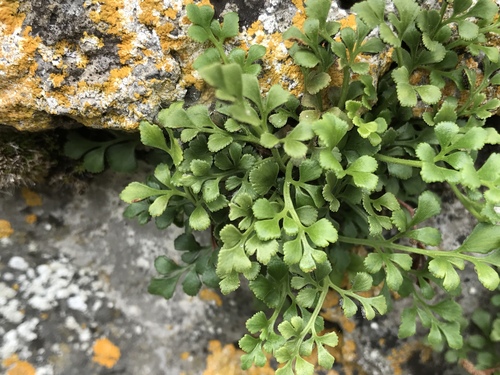
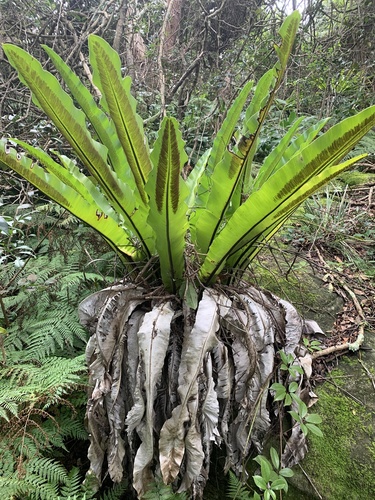
Asplenium australasicum (J.Sm.) Hook. is a shrubby fern that grows with a rosette of yellow-green fronds. Each frond measures 60 to 80 cm (24–32 in) long and 3 to 21 cm (1.2–8.4 in) wide. It can be told apart from Asplenium nidus by its prominent midrib on the underside of its fronds, which gives fronds a keeled appearance. Its spores develop in parallel lines that run alongside the veins and sit oblique to the midrib. This species is native to eastern New South Wales and Queensland. It grows on rocks, or as an epiphyte on trees. Clumps of this fern can grow to a large size, and the centre of the fern acts as a reservoir that holds debris. Colonial botanist William Woolls noted as a caution to fern gatherers that a species of black snake sometimes coils up in the centre of this birds nest fern. Specimens of Asplenium australasicum taken from logged areas helped the species gain popularity in horticulture. It adapts easily to cultivation when provided with good drainage. Poor drainage makes this fern vulnerable to rotting. It can be grown in a tub or barrel. In cultivation, white coconut scale occasionally attacks the underside of its fronds. Aside from being grown as an ornamental plant, this bird's nest fern is also a popular vegetable in Taiwan, especially in the eastern part of the island. Young emerging fronds of both A. australasicum and A. nidus, harvested from either wild or cultivated plants, are used as a leafy vegetable.