About Aspilia mossambicensis (Oliv.) Wild
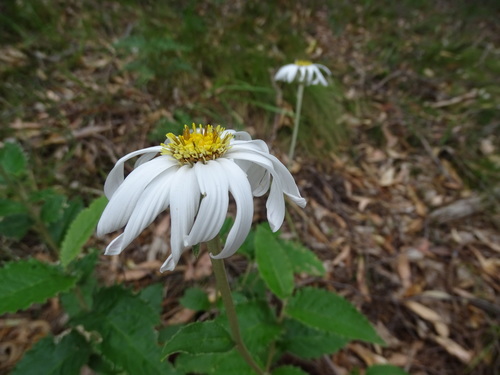
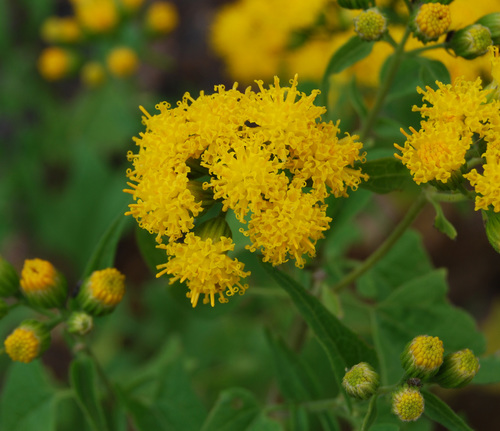
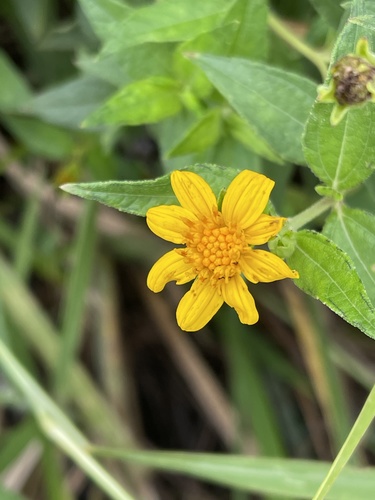
Aspilia mossambicensis, commonly called wild sunflower, is a medicinally useful herbaceous plant in the Compositae (Asteraceae) family. It has a widespread anthropogenic distribution across central and eastern tropical Africa, ranging from Ethiopia through East Africa, the Congo, Zambia, Zimbabwe, Malawi, and Mozambique to South Africa. It grows as a herb or shrub 0.5 to 1 meter tall, or a straggling bush reaching up to 2.5 meters high, with scabrid branches. Its leaves are sessile to shortly petiolate, shaped ovate or elliptic, measuring 2–12 by 1–3 cm. The leaf base is cuneate, margins are entire or serrate, and the apex is acute or attenuate. Leaves are scabrid on both surfaces and somewhat 3-nerved from the base, with petioles up to 1 cm long. Capitula are arranged in loose paniculate corymbs, borne on stalks up to 7 cm long. The involucre is 4–7 mm high; outer phyllaries are yellowish near the base, green near the apex, and covered in hispid-pubescent hairs. Paleae are 5–7 mm long, keeled with a dark midrib. There are 8–13 bright yellow ray florets, with rays 6–20 mm long that are glabrous or pubescent on the upper surface. Disk florets are yellow, 5–6.5 mm long, and often marked with dark stripes along the tube. Achenes are brown, obovoid, 4–5 mm long, and pilose. The pappus consists of several connate scales up to 0.4 mm long, plus 1–2 barbellate aristae 1–3 mm long. Herbalists and local communities use A. mossambicensis to treat malaria, bacterial infections, and HIV, as well as to reduce menstrual cramps. It is also used as a uterotonic to induce uterine contractions and labour during childbirth. This species is used alongside the Neem tree to control the breeding cycles of Nile tilapia, Oreochromis niloticus. Extracts from the two species inhibit early maturation and reproduction of the fish, addressing issues caused by mixed-age fish populations in commercial breeding ponds.