About Asparagus setaceus (Kunth) Jessop
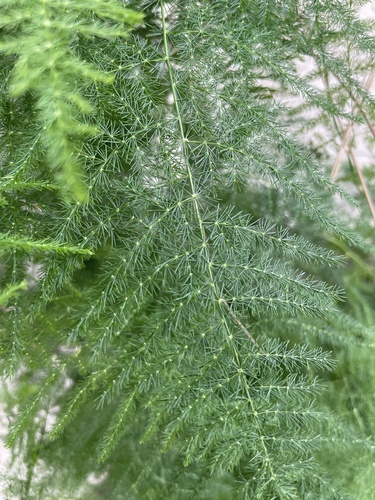
Asparagus setaceus (Kunth) Jessop is a scrambling evergreen perennial. It has tough green stems and modified leaf-like structures called cladodes (what appear to be leaves) that can reach lengths of several metres. These cladodes grow up to 7 mm long and 0.1 mm in diameter, emerging in clumps of up to 15 from the stem to create fine, soft, green, fern-like foliage. Sharp barbed thorns grow on the stems. Small greenish-white bell-shaped flowers, each 0.4 cm long, bloom from spring to autumn. These flowers are followed by small green berries that turn black when fully mature. The berries are reportedly toxic if eaten, and consumption causes diarrhea and abdominal pain.
Asparagus setaceus is native to Southern Africa, with its native range extending southwest to Calitzdorp in the Karoo. It is grown outside its native range as an ornamental plant, and has become invasive in several introduced locations. It is toxic to many domestic animals including dogs and cats; if animals ingest its berries, symptoms may include vomiting, diarrhea, abdominal pain, and allergic dermatitis. The toxic compound in the plant is sapogenin, a naturally occurring steroid.
Asparagus setaceus is cultivated as an ornamental plant for planting in gardens, containers, and as a houseplant. Its attractive foliage is also used in floral arrangements. It is hardy down to 1 °C (34 °F), but cannot tolerate freezing. Because of this, it is usually grown indoors in bright, indirect light in temperate zones. This plant has been awarded the Royal Horticultural Society's Award of Garden Merit.