About Asparagus officinalis L.
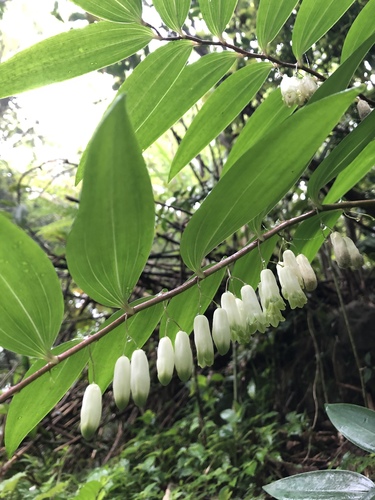
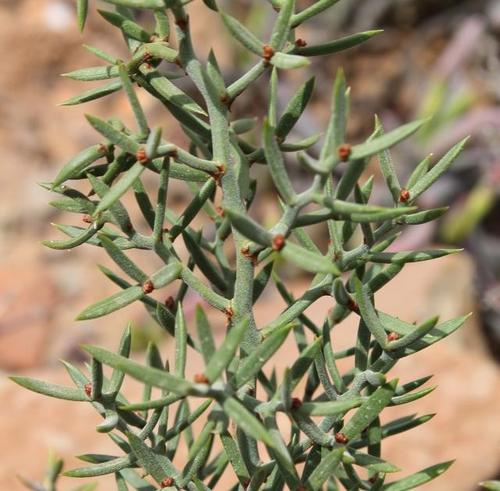
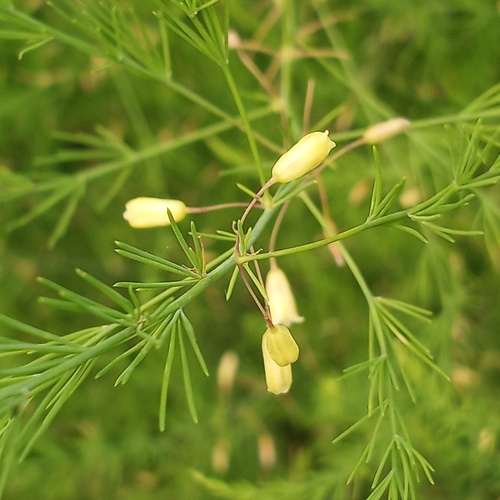
Asparagus officinalis L., commonly called asparagus, is an herbaceous perennial plant. It typically grows 100–150 centimeters (3–5 feet) tall, with stout stems that bear much-branched, feathery foliage, though it has been recorded growing as tall as 3.5 meters (11 feet). What appear to be leaves are actually needle-like modified stems called cladodes, which grow in the axils of small scale leaves. These cladodes measure 6–32 millimeters (1⁄4–1+1⁄4 inches) long and 1 millimeter (1⁄32 inch) broad, and grow in clusters of four to up to 15 arranged in a rose-like shape. The plant's root system, commonly called a 'crown', is adventitious with fasciculated roots. Its flowers are bell-shaped, ranging in color from greenish-white to yellowish, and measure 4.5–6.5 millimeters (3⁄16–1⁄4 inch) long, with six tepals that are partially fused at the base. Flowers grow singly or in clusters of two or three at the junctions of small branchlets. This species is usually dioecious, meaning male and female flowers grow on separate plants, though hermaphrodite flowers are sometimes found. The fruit is a small red berry 6–10 millimeters (1⁄4–13⁄32 inch) in diameter, which is toxic to humans.
Asparagus plants native to western coasts of Europe, ranging from northern Spain to northwest Germany, north Ireland, and Great Britain, are classified as A. officinalis subsp. prostratus (Dumort.) Corb. This subspecies is distinguished by its low-growing, often prostrate stems that reach only 30–70 cm (12–28 in) high, and shorter cladodes that measure 2–18 mm (3⁄32–23⁄32 in) long. Some authors treat this taxon as a separate distinct species, A. prostratus Dumort.
Sources disagree on the full native range of Asparagus officinalis, but most include most of Europe and western temperate Asia.
Because asparagus often originates in maritime habitats, it grows well in soils that are too saline for most common weeds to survive. For this reason, a small amount of salt was traditionally used to suppress weeds in asparagus growing beds; this method has the disadvantage that the soil cannot be used to grow any other crops afterwards. Some regions and gardening zones are more suitable for growing asparagus than others, including the west coast of North America and other maritime, Mediterranean-style environments. Soil fertility is a major factor in successful cultivation. Asparagus crowns are planted in winter, and the first young shoots emerge in spring; the first harvested shoots are called sprue asparagus, which has thin stems. In early 2011, a UK grower announced a new early-season asparagus variety that can be harvested two months earlier than standard varieties. This variety does not require a dormant period and begins growing at 7 °C (45 °F), instead of the typical 9 °C (48 °F) required by standard asparagus.
Purple asparagus differs from green and white asparagus in having higher sugar content and lower fiber levels. It was originally developed in Italy near the city of Albenga, and commercialized under the variety name 'Violetto d' Albenga'. Purple asparagus can turn green during cooking because it is sensitive to heat. The genome of Asparagus officinalis has been sequenced, and the species is used as a model to study the evolution of sex chromosomes and dioecy in plants.