About Asio stygius (Wagler, 1832)
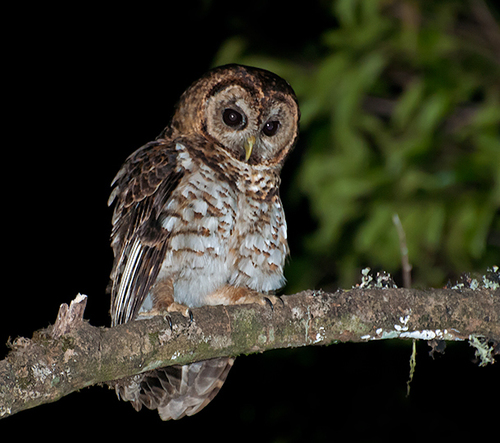
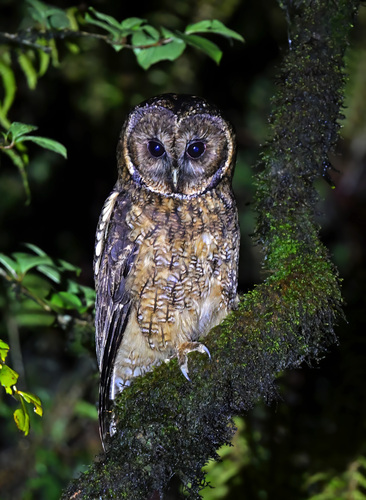
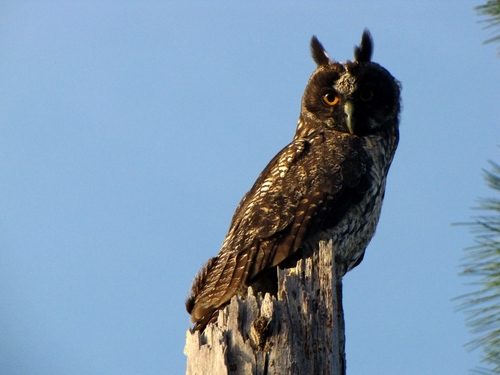
The Stygian owl (Asio stygius (Wagler, 1832)) measures 38 to 46 cm (15 to 18 in) in length and weighs approximately 400 to 675 g (14 to 24 oz). Both sexes share similar very dark plumage; the term "Stygian" originally refers to the River Styx, and is generally used to describe anything dark or dismal. Its face is blackish with a pale border and a whitish forehead, and the head bears long dark feathers that project upward as "ears". The dark upperparts have buff streaks and bars, while the underparts are a dull buff with dark brown or blackish streaks and barring. The eyes are yellow-toned, the bill ranges from blue-black to blackish, and the feet are dark grayish or brownish pink. Due to their reflective structure, the eyes can look crimson under certain lighting conditions. Recognized subspecies are mostly similar to one another, differing mainly in the shade of streaks on the upperparts and to a small degree in size. Below is the documented distribution of Stygian owl subspecies, with taxonomic disagreements noted further on: A. s. lambi occurs in northwestern Mexico, from Sonora and Chihuahua south to Jalisco. A. s. robustus occurs discontinuously from Guerrero and Veracruz in Mexico south into northern Nicaragua. A. s. siguapa occurs on mainland Cuba and Isla de la Juventud (Isle of Pines). A. s. noctipetens occurs on mainland Hispaniola and Gonâve Island. A. s. stygius occurs from Colombia and Venezuela south to Bolivia, and discontinuously in central and southern Brazil. A. s. barberoi occurs in Paraguay and northern Argentina. In addition to these core ranges, the Stygian owl has been recorded as a vagrant in Texas, Florida, and Trinidad. Multiple taxonomic disagreements exist between researchers: some authors merge A. s. lambi into A. s. robustus, some extend the range of A. s. robustus to cover the Colombian, Ecuadorian, and Venezuelan populations that are otherwise assigned to A. s. stygius, some include A. s. noctipetens within A. s. siguapa, and some classify the southeastern Brazil population as part of A. s. barberoi instead of A. s. stygius. The Stygian owl lives in a wide range of landscapes, from sea level up to 3,000 m (9,800 ft) in elevation. Most of its habitats are fairly open, neither densely forested nor entirely grassland. Habitats occupied by the species include montane pine, pine-oak, and cloud forests, thorn scrub, cerrado, pine plantations, and even urban parks.