About Asio otus (Linnaeus, 1758)
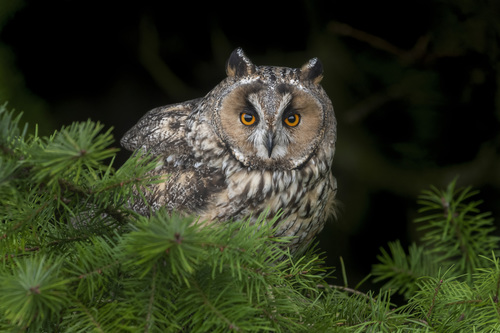
The long - eared owl (Asio otus) is a slim, long - winged owl with erectile ear tufts positioned closer to the head's center than in many other owl species. The function of ear tufts is uncertain, though a theory suggests they aid in intraspecies communication. The owl's general coloration is ochraceous - tawny with grayish or brownish washes and variable blackish vertical streaks and spots, especially on the wings and back. The scapulars are whitish, and the wings have dark carpal patches and buff or orange panels. The underside is paler than the upperside, with dusky streaks on the upper breast and a herring - bone pattern below. There is individual and regional variation in markings, with forest - dwelling owls being darker and desert - dwelling ones lighter. The facial disc is well - developed, variably colored, and rimmed dusky with white lines. The ear tufts are dusky in front and tawny on the back. The owl has a blackish bill and eyes that range from yellowish - orange to orange - red, and its tarsi and toes are feathered. It is a medium - sized owl, 31 - 40 cm long with a wingspan of 86 - 102 cm. It is lighter and slenderer than similar - sized owls like the barn, short - eared, and tawny owls, and shows reverse sexual dimorphism, with females larger and often darker than males. Males weigh 160 - 330 g and females 180 - 435 g. In standard measurements, wing chord length is 262 - 315 mm in males and 255 - 332 mm in females, tail length is 121.5 - 161 mm in males and 143.5 - 165 mm in females, bill length averages 15.7 mm in males and 16.2 mm in females, and tarsus length averages 38.2 mm in males and 39.9 mm in females. The long - eared owl has a wide skull, small eyes and orbits, an elongated but weak beak, long and thin legs, and fine but sharp talons. An experienced observer can usually distinguish it by field marks, size, and coloration, but it can be confused with other species such as the Stygian, tawny, Eurasian eagle, great horned, scops, screech, marsh, and short - eared owls. The long - eared owl has large, asymmetrically placed ear slits, with the left higher and the right lower. The right ear is about 13% larger. Its hearing is about ten times better than humans' for high and medium pitches. Its vocalizations are highly variable, with 23 different vocalizations recorded in Michigan. The male's song is a deep whoop, around 400 hertz, carrying up to 1 - 2 km on calm nights. The female's song is weaker, higher - pitched, and nasal. Both sexes utter cat - like or high yip - yip notes, and when disturbed near the nest, they make tinny tones. The male makes a clapping sound during courtship flight. All ages hiss and snap their bills when threatened. Fledging young make high - pitched, drawn - out notes. The long - eared owl has an extremely large range. In Eurasia, it is found from the Iberian Peninsula and the British Isles, across Europe, in parts of Scandinavia, North Africa, Turkey, the Middle East, Russia, Central Asia, and East Asia. It winters in parts of southern Europe, the Middle East, and South Asia. In North America, it breeds in western and central parts of Canada and the United States, and is more widespread in the non - breeding season. It can be found as far south as Mexico. The optimal habitat for the long - eared owl has open spaces with short vegetation and abundant prey, along with wooded cover for roosting and nesting. It can live at various elevations but is usually absent above the montane tree line. It inhabits open landscapes with trees, forests with clearings, swamps, orchards, parks, and even urban areas. It has adapted to deserts in some regions. In different regions, it shows preferences for certain habitats, such as conifer stands in the United States. It is more confined to temperate zones compared to the short - eared owl.