About Asio flammeus (Pontoppidan, 1763)
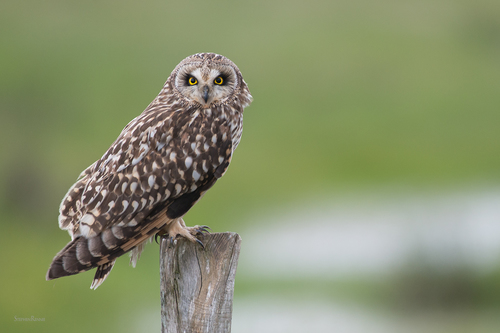
The short-eared owl, with the scientific name Asio flammeus (Pontoppidan, 1763), is a medium-sized owl. It measures 34–43 cm (13–17 in) in length and weighs 206–475 g (7.3–16.8 oz), with a wingspan ranging from 85 to 110 cm (33 to 43 in). Females are slightly larger than males. It has a big head, short neck, large eyes, and broad wings. Its bill is short, strong, hooked, and black. Its plumage is mottled tawny to brown, with a barred tail and barred wings, and the upper breast is significantly streaked. Its yellow-orange eyes are framed by black rings encircling each eye (which gives the appearance the owl is wearing mascara), and large whitish disks of plumage surrounding the eyes like a mask. Its flight is characteristically floppy due to irregular wingbeats, and is often described as moth or bat-like. Multiple published academic works have discussed the field identification of short-eared owls relative to long-eared owls. The short-eared owl occurs on all continents except Antarctica and Australia, giving it one of the most widespread distributions of any bird. It breeds in Europe, Asia, North and South America, the Caribbean, Hawaii, and the Galápagos Islands. It is partially migratory, moving south in winter from the northern portions of its range. This species is known to relocate to areas with higher rodent populations, and will wander nomadically in search of better food supplies during years when vole populations are low. The short-eared owl hunts mostly at night, but is also active during the day (diurnal) and at twilight (crepuscular). Its daytime hunting typically coincides with the peak activity periods of voles, its preferred prey. It tends to fly only a few feet above the ground in open fields and grasslands, before swooping down feet-first onto its prey. Multiple owls may hunt over the same open area. Its diet consists mainly of rodents, especially voles, but it will eat other small mammals including rabbits, mice, ground squirrels, shrews, rats, bats, muskrats, and moles. It also occasionally preys on smaller birds: this happens semi-regularly near sea coasts and adjacent wetlands, where it attacks shorebirds, terns, small gulls, and seabirds. Avian prey is taken less often inland, where it is mostly limited to passerines such as larks, icterids, starlings, tyrant flycatchers, and pipits. Insects supplement its diet, and short-eared owls may prey on roaches, grasshoppers, beetles, katydids, and caterpillars. In North America, competition is fierce between the short-eared owl and the northern harrier, which shares similar habitat and prey preferences. Both species will readily harass the other when one individual catches prey. Because the stomach of owls has a high pH that reduces their ability to digest bone and other hard parts, they eject pellets containing the undigested remains of their prey.