About Asio capensis (A.Smith, 1834)
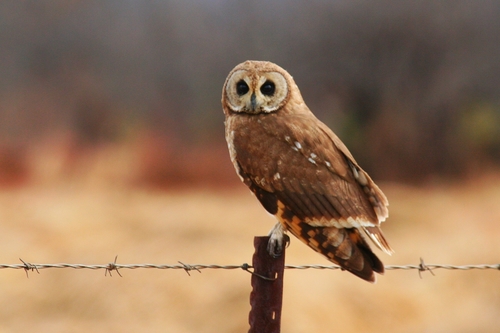
This species, the Cape marsh owl, is a medium-sized owl with dark brown plumage and a pumpkin-shaped head marked by small 'ear' tufts. Its facial disc is pale buff, bordered by a distinct dark brown rim with buff speckles. A dark brown area surrounds the dark brown eyes. The ear-tufts are earth-brown, quite small (often not visible), and positioned near the center of the forehead. The dark brown tail has pale buff bars and a whitish tip. The tarsi are feathered in pale tawny-buff, while the toes are covered in pale buffish plumes that leave the dark brown toe tips bare. The claws are blackish. Males are generally paler than females, and there is some individual variation in plumage tone. Adults measure 31–38 cm in total length, have a wing length of 284–380mm, a tail length of 132–186mm, and weigh 225–485g.
Marsh owls prefer habitats of open grassland, marshlands, and short scrub, most often located near marshy grounds, vleis or dams. They nest on the ground, and have been observed to leave areas during periods of drought. Their preferred habitat is often vulnerable to destruction from agriculture or overgrazing.
The marsh owl has a fragmented distribution. It is common in the grasslands of southern Africa, ranging from northern regions of South Africa down to the Eastern Cape province. It also occurs on the Mashonaland plateau in Zimbabwe, and in the Makgadikgadi lacustrine depression in Botswana. It has been recorded on the floodplains of the Namibian coast, and also exists as isolated populations in Morocco and Madagascar.