About Asimina pygmaea (W.Bartram) Dunal
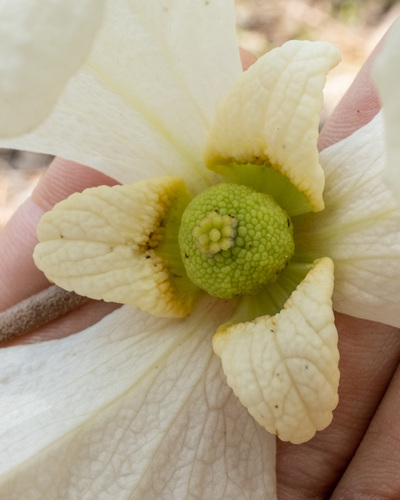
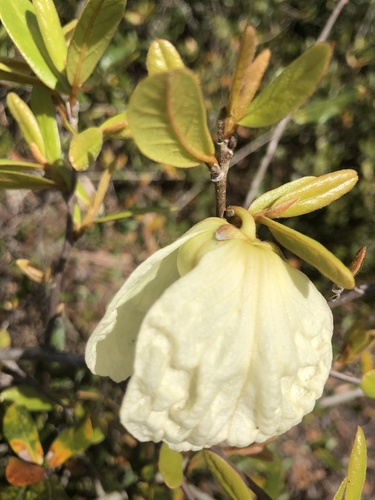
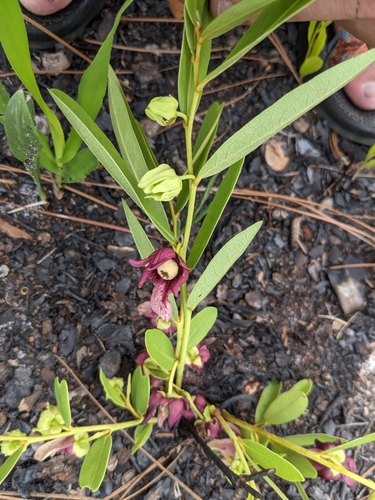
Asimina pygmaea (W.Bartram) Dunal is a shrub that grows 20–30 centimeters tall. It produces a spindle-shaped taproot, from which one or more branched or unbranched shoots emerge. The shoots have red to brown bark marked with lenticels. Its leathery leaves measure 4–11 centimeters long, with rounded or blunt tips that occasionally have a notch. Leaf margins are rolled toward the underside of the leaf. The upper surface of the leaves is dark green and hairless, while the underside is paler and marked with a networked vein pattern. The plant's twisted petioles are 3–10 millimeters long. Flowers form on thin, axillary peduncles 1.5–4 centimeters long. The flowers are brown-crimson, and have a strong scent similar to yeast or rotting flesh. Each flower has 6 petals arranged in two rows of three. The fleshy, outer petals are oblong to oval, 1.5–3 centimeters long, and rolled downward toward their outer surface. The fleshy, oval inner petals are 0.5–2 centimeters long, and are a deeper color than the outer petals. The base of the inner petals is swollen, and wrinkled on the inner surface, while the tips of the inner petals are rolled back. The mature stamens are globular, 4–7 millimeters wide, and range from light green to pink. Flowers bear 2–5 carpels. The fruits are yellow-green, curved cylinders 3–4 centimeters long. The fruits hold brown, shiny seeds, each 1 centimeter long, arranged in two rows. This species has been observed growing in well-drained sandy soils within pine flatwoods, savannahs, and old fields.