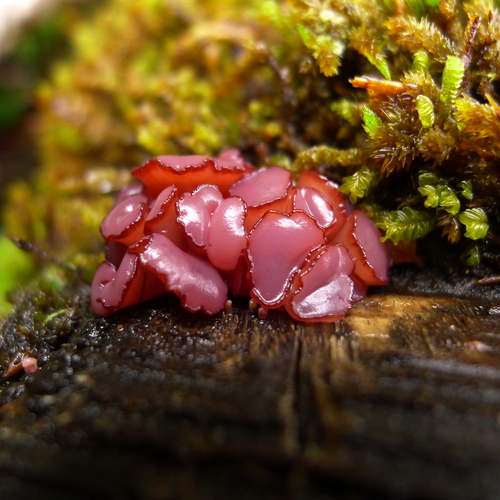
About Ascocoryne sarcoides (Jacq.) J.W.Groves & D.E.Wilson
Ascocoryne sarcoides is a fungus distinguished by its sexual fruiting body, called an apothecium, which is pinkish-purple and has a more or less gelatinous texture. Individual apothecia typically measure 0.5 to 1.5 centimetres (1⁄4 to 5⁄8 in) in diameter. They begin as roughly spherical, and eventually flatten out into a shallow cup shape with a wavy edge and a smooth upper surface. The lower surface may be covered in small granular particles. Apothecia are either sessile, meaning they attach directly to their growing surface, or have a rudimentary stem. This fungus also produces a conidial, asexual form that generates non-sexual spores. This asexual form consists of sporodochia: cushion-like masses of asexual fruiting bodies made up of short conidiophores, the specialized stalks that bear asexual spores called conidia. The sporodochia match the apothecia in color and consistency, but have highly variable shapes, typically taking club, spoon, or tongue forms. They bear minute, cylindrical conidia that can be straight or curved. As the fungus matures, apothecia enlarge, press against one another, and coalesce into an irregular, gelatinous mass. The flesh of Ascocoryne sarcoides matches the fungus's overall appearance: it is pinkish-purple and gelatinous. The species has no distinctive odor or taste, and it is not considered edible. This saprobic fungus gets nutrients from decaying organic matter, and has a broad distribution across forested areas of North America and Europe. It most commonly grows on stumps and logs of fallen deciduous trees, but can also be found on a variety of living trees. For example, in Europe, it has been recorded growing on the stems of living Norway spruce (Picea abies) in Finland, France, Great Britain, Norway, and Germany. Additional confirmed collection sites include Australia, Chile, China, Cuba, Iceland, Korea, and Taiwan. In Hawaii, it grows on the trunks of fallen Cibotium and Aleurites trees. It occurs most often in late summer and autumn.

