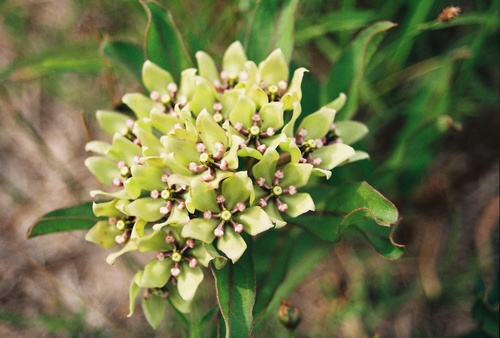
About Asclepias viridis Walter
Asclepias viridis Walter is a species of milkweed, a member of the dogbane plant family. It is commonly known as green milkweed, green antelopehorn, and spider milkweed; its specific epithet viridis is the Latin word for green. This plant is native to the midwestern, south central, and southeastern United States, as well as the southeastern portion of the western United States.
A. viridis is a perennial forb with alternately arranged leaves. Its inflorescence is an umbel bearing white flowers with purplish centers. It has a taproot root system, the same type found in butterfly weed (Asclepias tuberosa). It can grow on many different soil types, and is most commonly found in overgrazed pasture land and along roadsides.
Like some other milkweed species, A. viridis is a host plant for the monarch butterfly (Danaus plexippus). It is one of the most important host plants in the southern United States for the generation of monarch butterflies that develop from eggs laid by monarchs that have completed wintering in Mexico. Monarch Watch provides information about rearing monarchs and their host plants. Efforts to restore declining monarch butterfly populations by creating butterfly gardens and monarch migratory "waystations" require specific attention to the target species' food preferences and population cycles, as well as the conditions needed to propagate and maintain their food plants. In the southern Great Plains and the western United States, for example, monarchs reproduce on A. viridis, especially when the plant's foliage is soft and fresh. Because monarch reproduction peaks in these regions during late summer and early fall, when older milkweed foliage becomes old and tough, A. viridis needs to be mowed or cut back in July to ensure it will regrow rapidly by the time monarch reproduction reaches its peak.
A. viridis is one of the first milkweed species to bloom in the Ohio River Valley, with flowering occurring from May to June. In this region, caterpillars of the monarch butterfly and the milkweed tussock moth (Euchaetes egle) are rarely found on this plant, because A. viridis sheds its leaves and becomes dormant in late June to early July, before these two Lepidoptera species arrive. In Texas, A. viridis is dormant by July and may re-sprout in the fall in some years, while in other years it stays green through the entire summer and blooms a second or third time.
This plant is difficult to cultivate and does not grow well in containers. Seeds of many milkweed species, including this one, require a period of cold treatment (cold stratification) before they can germinate. To protect seeds from washing away during heavy rains and from being eaten by seed-eating birds, seeds can be covered with a light fabric or a 0.5 inch (13 mm) layer of straw mulch. However, mulch acts as an insulator. Thicker layers of mulch can prevent seeds from germinating if they keep soil temperatures from warming enough after winter ends, and few seedlings can push through a thick layer of mulch.