About Asclepias verticillata L.
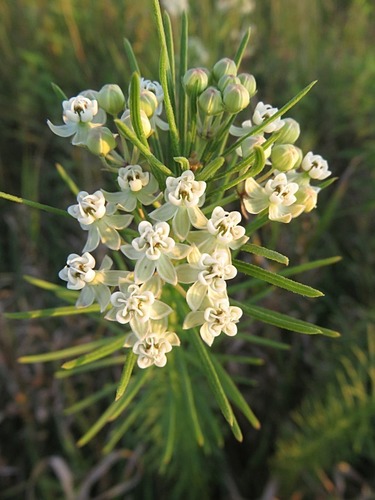
Asclepias verticillata L. is a perennial herb that grows a single stem ranging from 6 inches to 3 feet in height. Its very narrow, linear leaves grow in whorls of 4–6, with short internodes between leaf clusters. It produces an umbel inflorescence holding 7–20 greenish white flowers. The Latin specific epithet verticillata refers to the whorled arrangement of its leaves. This species is native, and occurs in habitats including loblolly pine plantations, upland pine-hardwood communities, glades, and along roadsides. It grows primarily in sandy soils, and requires light levels ranging from full sunlight to partial shade; it can tolerate both xeric dry and moist growing conditions. Its fragrant flowers bloom from June to September, with peak flowering occurring in August, and fruiting also takes place within this same time window. Asclepias verticillata is native to habitat types that follow a natural fire regime, so many wild populations are exposed to repeated annual burns. This species survives burns successfully, and its population frequency increases in response to repeated prescribed fires. It can reproduce vegetatively and does not rely on pollinators to reproduce, though it does produce nectar, most heavily during early evening hours. Common insect visitors to the plant include wasps, honeybees, and lepidopterans such as moths and the cabbage white butterfly. Like other milkweed species, Asclepias verticillata acts as a host plant for the monarch butterfly, whose caterpillars feed on its leaves. This plant is toxic to livestock. It was used as a medicinal plant by multiple Native American peoples: the Choctaw used it to treat snakebite, the Lakota and Hopi used it to increase breast milk production in nursing mothers, and the Navajo used it to treat nose and throat problems.