About Asclepias tuberosa L.
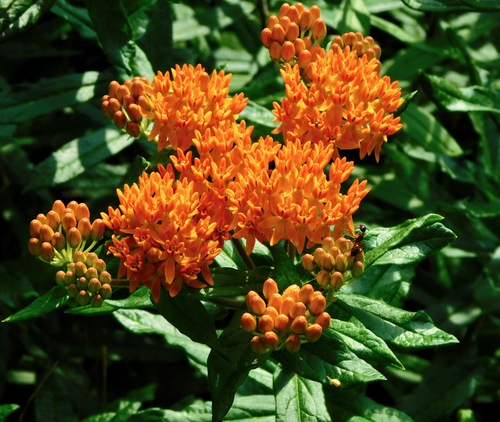
Asclepias tuberosa L. is a perennial plant that reaches 0.3–1 m (1–3+1⁄2 ft) in height. Its leaves are spirally arranged, lanceolate, measuring 3–12 cm (1+1⁄4–4+3⁄4 in) long and 2–3 cm (3⁄4–1+1⁄4 in) broad. From April to September, 7.5 cm (3 in) wide umbels of flowers grow from upper leaf axils. Individual flowers are 1.5 cm (1⁄2 in) wide, and can be orange, yellow, or red, with five petals and five sepals. It remains unknown whether reddish flower color comes from soil mineral content, genetic differentiation between ecotypes, or a combination of both factors. The cultivar "hello yellow" consistently produces more yellowish flowers than typical wild Asclepias tuberosa. The plant's fruit pod is 7.5–15 cm (3–6 in) long, and holds numerous long-haired seeds. This species is distributed from South Dakota south to Texas and Mexico, west to Utah and Arizona, and across many additional areas further east. It grows best in dry sandy or gravelly soil, though it has also been recorded growing along stream margins, and it requires full sun. Asclepias tuberosa is most easily propagated from seed. Its primary pollinators are bees and wasps, rather than butterflies. When sown outdoors after the last frost, plants will flower and produce seed by their third year. Once established, it is difficult to transplant because it has a deep, woody taproot. This species is a larval food plant for queen and monarch butterflies, as well as the dogbane tiger moth, milkweed tussock moth, and unexpected cycnia. Due to its rough leaves and trichomes, it is not a preferred host plant for monarch butterflies, but monarch caterpillars can be successfully reared on it. Additionally, it has one of the lowest cardenolide contents of any Asclepias species, which means it provides poor protection from bird predation and parasite virulence, and this may contribute to why egg-laying monarchs are not attracted to it. Asclepias tuberosa is largely unaffected by repeated prescribed burns. This plant contains toxic glycosides, alkaloids, and resinoids. Consumption of these compounds can cause weakness, seizures, and corneal injuries. Use of the plant is contraindicated during pregnancy, during lactation, and for infants, due to its toxins including resinoids and pregnanes. Asclepias tuberosa, commonly called butterfly weed, is frequently grown in gardens for its showy orange flowers, which are especially attractive to bees, though they are also visited by hummingbirds, moths, and butterflies. It grows easily from seed and is difficult to transplant due to the large size of its taproot. Plants grown from seed take about two to three years to reach flowering size under average conditions. Its seeds do not require stratification and can be planted immediately, though commercial growers generally cold moist stratify them at 5 °C for 30–60 days, as this treatment increases germination rate. For other milkweed species, a 1–2 cm thick layer of mulch increases germination rate, but no specific research has tested this effect for butterfly weed. Butterfly weed has few serious pest or disease problems. It is susceptible to crown rot if planted in poorly drained or consistently too moist locations, and it is hardy in USDA zones 3–9. Native Americans and European pioneers used boiled roots of the plant to treat diarrhea and respiratory illnesses. Young seed pods were eaten after boiling in several changes of water. The soft down from seed pods was spun to make candle wicks. The root was historically used to treat pleurisy.