About Asclepias syriaca L.
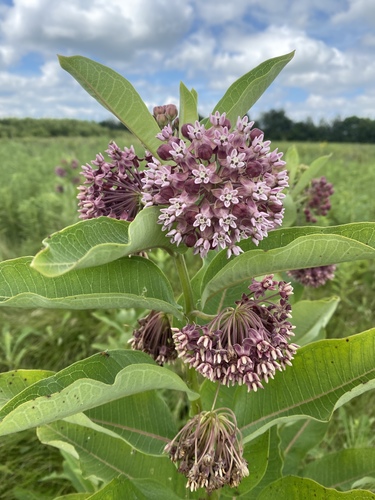
Asclepias syriaca L. (common milkweed) is a clonal perennial forb, with individual plants growing from propagative roots. All parts of the plant produce white latex when cut. It typically reaches 3 to 5 feet (0.91 to 1.52 m) tall, and can grow up to 8 ft (2.4 m) in ditches and gardens. Its simple leaves are opposite (sometimes whorled), broadly ovate-lanceolate, 1.5–4.75 inches (3.8–12.1 cm) wide, with usually entire, undulate margins and reddish main veins. Leaves have very short petioles and velvety undersides. Highly fragrant, nectariferous flowers range from rarely white to pinkish and purplish, and grow in umbellate cymes. Individual flowers are about 1 cm (0.4 in) in diameter, each with five horn-like hoods and five pollinia. Seeds, each attached to long, white flossy hairs, form inside large follicles. Fruit production from self-fertilization is rare; in three study plots, outcrossed flowers had an average fruit set of about 11%.
Within its native range, A. syriaca grows in a wide variety of habitats including croplands, pastures, roadsides, ditches, and old fields. More than 450 insect species feed on this plant, including flies, beetles, ants, bees, wasps, and butterflies. It is one of the most important food sources for monarch butterfly (Danaus plexippus) caterpillars in the northeastern and midwestern United States, and is one of only three milkweed species the eastern monarch migration largely depends on. Cardenolide fingerprinting analysis shows that 85-92% of monarchs overwintering in Mexico fed on A. syriaca as caterpillars. In 2024, the National Capital Planning Commission (the U.S. federal planning agency for the National Capital Region) released a "Pollinator Best Practices Resource Guide" that notes while over 100 milkweed species are native to North America, A. syriaca "is clearly an important species that is critical to the survival of monarch butterflies". Other insect species that feed on A. syriaca include the red milkweed beetle (Tetraopes tetraophthalmus), the milkweed tussock caterpillar (Euchaetes egle), the large milkweed bug (Oncopeltus fasciatus), the small milkweed bug (Lygaeus kalmii), and the nonnative oleander aphid (Aphis nerii), which can become abundant on milkweed shoots. Many insect species visit A. syriaca flowers, and some act as pollinators, including the Western honey bee (Apis mellifera) and native bumblebees (Bombus spp.). In the U.S. mid-Atlantic region, introduced A. mellifera was found to be the most "effective" pollinator, but it more often visits flowers on the same individual plant. Since A. syriaca has a high level of self-incompatibility, A. mellifera is less effective for flower fertilization than Bombus spp., which are more likely to visit unrelated individual plants.
Monarch butterfly populations can decline when milkweeds are removed with herbicides. The development and widespread cultivation of herbicide-resistant staple crops like corn and soybeans has caused a massive reduction in weeds and native plants including milkweeds, and this has played a significant role in the monarch butterfly's population decline. In 2018, the CEO of the National Wildlife Federation stated that the monarch butterfly population had dropped by 90 percent over the previous 20 years, and cited reduced milkweed availability as a contributing factor. Many regions of the United States have seen declining milkweed populations due to factors including increased habitat loss from development, roadside median mowing, and herbicide use. Even so, human-caused deforestation has expanded the range and density of A. syriaca in some regions. A. syriaca is now naturalized in many areas outside its native range, which extends from central and eastern Canada to north central and eastern United States. It has naturalized in at least 23 countries worldwide, with introduced locations including Oregon, Newfoundland, the southeastern United States, most of Europe, and parts of western Asia. It has been listed as an invasive alien species in the European Union since 2017, so importation and trade of the plant is prohibited within the Union. Over 40 distinct pathogens affecting Asclepias species have been identified, including two dozen that infect A. syriaca; one example is milkweed yellows, an infectious disease caused by the milkweed yellows phytoplasma, a cell-wall-less bacterial strain.
In cultivation, A. syriaca can become aggressive, as it spreads via propagative roots, so it may not be suitable for small gardens and formalized plantings. It is winter hardy in USDA zones 3–9. It prefers moist but well-drained soils, though it tolerates dry conditions and clay soils. It grows best in full sun, but can tolerate light shade, though it may produce fewer flowers in shaded conditions. It works well in semi-dry locations where it can spread without harming other ornamental species. Monarch Watch provides information on rearing monarchs and their host plants. Efforts to restore declining monarch butterfly populations by establishing butterfly gardens and monarch migratory "waystations" require attention to the target species' food preferences and population cycles, as well as the conditions needed to propagate and maintain their food plants. In the northeastern United States, monarch reproduction peaks in late summer, when most A. syriaca leaves are old and tough. If plants are mowed or cut back between June and August, they regrow rapidly from their roots in time for peak monarch egg-laying, when reproducing females prefer quickly-growing shoots with tender, soft foliage.
A. syriaca can be grown from seeds or propagative root cuttings. A U.S. Department of Agriculture conservation planting guide for Maryland recommends that for optimum wildlife and pollinator habitat in mesic sites, a seed mix with 30 seeds per square foot of planting area should contain 17.0% A. syriaca by weight and 6.0% by seed. A. syriaca seeds require a period of cold stratification before they will germinate. To protect seeds from washing away in heavy rain and from being eaten by birds, seeds can be covered with a light fabric or a 0.5 in (13 mm) layer of straw mulch. However, mulch acts as an insulator: thicker mulch layers can prevent germination if they stop soil temperatures from rising enough at the end of winter, and few seedlings can push through a thick mulch layer. Both seedlings and cuttings usually bloom in their second year, though cuttings will occasionally bloom in their first year.
The latex of A. syriaca contains large amounts of cardiac glycosides, so leaves and stems of old, tall plants are toxic to humans and large animals. Young shoots, young leaves, flower buds, and immature fruits are edible raw. In his 1962 book Stalking the Wild Asparagus, author Euell Gibbons wrote that milkweed is bitter and toxic, though he may have accidentally prepared the poisonous, similar-looking common dogbane (Apocynum cannabinum) instead. Gibbons created a method to remove bitterness and toxicity by plunging young shoots into boiling water for one minute, repeating the process at least three times to make the plant safe to eat. Some modern foragers consider the bitterness and toxicity claim a myth, stating the plant has no bitterness when eaten raw, and can be cooked like asparagus without special processing. A. syriaca has been studied as a source of rubber from its latex, and as a fiber source from its seed fluff. The fluffy seed hairs have traditionally been used as a mounting background for pinned butterflies and other insects, and compressed floss has a silk-like sheen. The plant has also been investigated for commercial use of its strong, soft bast (inner bark) fiber. U.S. Department of Agriculture studies conducted in the 1890s and 1940s found that common milkweed has more commercial processing potential than any other indigenous bast fiber plant, with estimated yields as high as hemp and quality as good as flax. Historically, Native Americans used both bast fiber and seed floss for cordage and textiles. Milkweed has also been commercially cultivated to make insulation for winter coats. Traditionally, the plant was used to treat respiratory infections such as pleurisy in both North America and Europe.