About Asclepias sullivantii Engelm. ex A.Gray
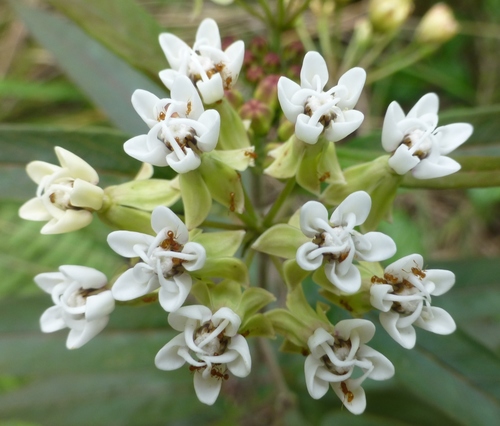
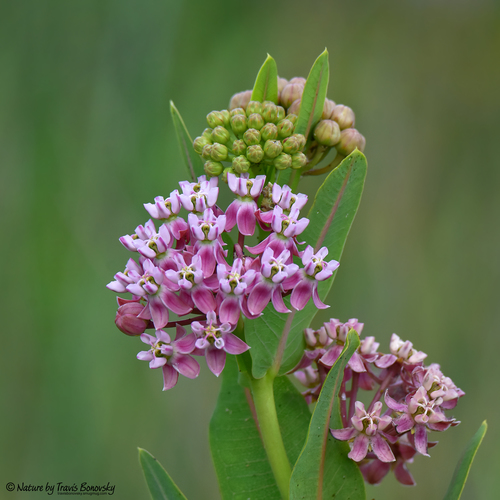
Asclepias sullivantii Engelm. ex A.Gray is a perennial herb that grows from deep rhizomes. Its stem reaches heights between 40 centimeters and just over one meter tall. The species has ovate, pointed, oppositely arranged hairless leaves that are thick and leathery, with wavy margins, reddish midveins, and curve upward along the stem. Pale to deep pinkish purple flowers grow in rounded clusters from the leaf axils. The plant produces a greenish follicle as its fruit. While its flowers are insect-pollinated, the species often reproduces vegetatively through its rhizomes. This species is very similar to common milkweed (Asclepias syriaca), and the two readily hybridize. Common milkweed can be told apart from Asclepias sullivantii by several traits: it has blunt-tipped leaf blades with a coating of hairs on the undersides, its leaves grow straight on the stem rather than curving upward, it produces smaller, more numerous flowers, and its follicle has a rougher surface. The native habitat of this plant includes prairies and meadows, and it grows in moist locations such as river bottomland. Asclepias sullivantii originally occurred across the tallgrass prairie region, but very little of this original habitat remains today due to widespread conversion to agricultural land. In Minnesota, the species is listed as a threatened species mainly because of habitat loss, and remaining populations are found on old railroad right-of-ways that preserve small prairie remnants. The species is restricted to mesic tallgrass prairies and appears to have very little ability to survive in degraded habitats. A range of insect species take nectar from this plant, including bumblebees, other bees, wasps, ants, flies, and butterflies. Monarch butterfly caterpillars feed on its foliage. Larvae of the milkweed leaf-miner Liriomyza asclepiadis create leaf mines within its leaves. Three aphid species that can be found on the plant are the yellow milkweed aphid (Aphis nerii), black aphid (Aphis rumicis), and green peach aphid (Myzus persicae). The ruby-throated hummingbird also feeds on nectar from this plant. Like most species in the Asclepias genus, Asclepias sullivantii contains cardiac glycosides and is toxic if consumed in large quantities.