About Asclepias stenophylla A.Gray
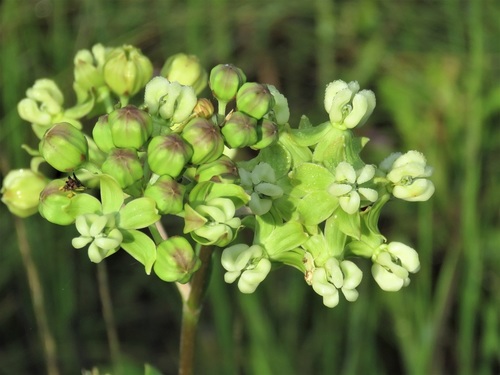
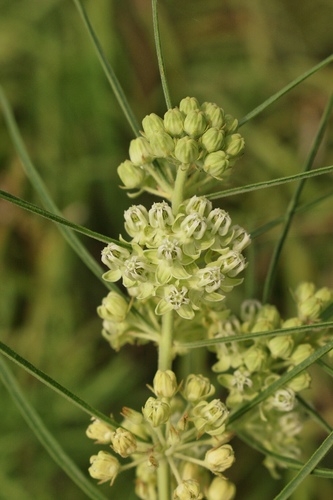
Asclepias stenophylla, commonly called slimleaf milkweed, is a herbaceous perennial plant. It typically grows one or two slender, usually unbranched stems, though it rarely produces more stems. Stems reach 30 to 80 centimeters (1–2.5 ft) tall, and may occasionally grow up to 1 meter (3.3 ft) in length. This species grows from a thick, carrot-like storage taproot that extends downward to depths of 30 to 100 centimeters (1.0–3.3 ft). Stems range from covered in short, erect, narrow hairs (puberulent) to nearly hairless. Like all prairie milkweed species except butterfly weed (Asclepias tuberosa), it produces milky sap. Its narrow leaves are attached to stems in an alternate, nearly opposite, or fully opposite arrangement; leaves are linear, shaped like grass blades, 5–16 centimeters (2.0–6.3 in) long and only 0.1–0.5 cm wide. Pale greenish to yellow flowers are arranged in axillary umbels, each holding 10 to 25 flowers. The umbels are nearly stalkless (subsessile) or have very short stalks (peduncles). The flowers have very small horns that are attached to the flower hoods for most of their length, with only the short tip and terminal lobes left free. Fruits are upright, slender follicles that measure 9 to 12 cm long. Flowering occurs from June through August. Slimleaf milkweed grows in dry prairies and forest openings. It tolerates a wide range of soil types, including rocky, sandy, and clay soils, and grows over substrates formed from different rock types including limestone, dolomite, and rhyolite. In Minnesota, it has been recorded growing in gravelly soils at the base of southwest-facing hill prairies, which matches the species' typical habitat (including limestone glades) found in other U.S. states. It occurs at elevations ranging from 70 meters (230 ft) to 1,900 meters (6,200 ft). Asclepias stenophylla grows natively from southeastern Minnesota through the Great Plains, extending to southeastern Montana, northern Texas, and east to South Dakota, Missouri, and Arkansas. It has conservation listing in multiple U.S. states: it is listed as endangered in Illinois, where it occurs on hill prairies in the western portion of the state; it is listed as endangered in Minnesota, where populations are thought to result from natural range expansion and lie 500 km from the species' main range; it is listed as endangered in Iowa, where it occurs in the far western part of the state, at the northeastern edge of the species' current natural range; and it is listed as a species of concern in Montana.