About Asclepias speciosa Torr.
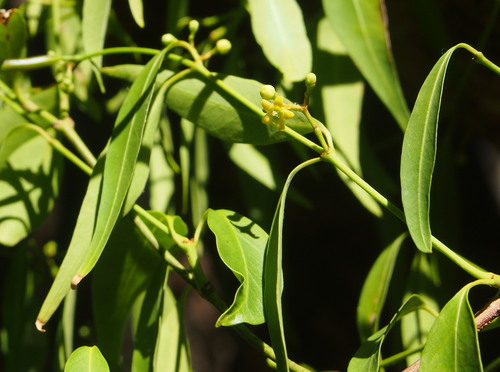
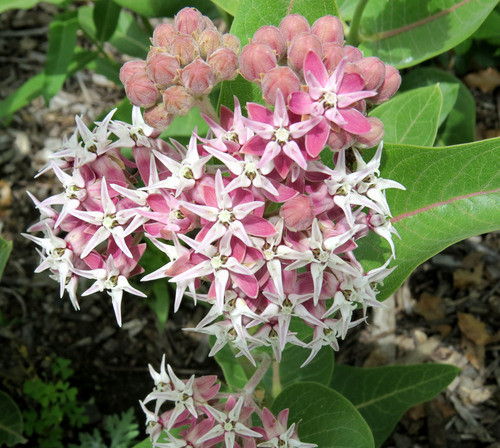
Asclepias speciosa Torr. is a hairy, erect perennial flowering plant that reaches up to 120 cm (47 in) in height. Its pointed, elongated, simple leaves with smooth unbroken margins measure 10–20 cm (4–8 in) long, and are arranged oppositely along stems. Bruising or cutting the leaves or stems releases milky sap. The plant’s flowers are around 2 cm (3⁄4 in) wide, covered in coarse hairs, and range in color from pale pink to pinkish-purple, growing in dense umbellate cymes. The flower corollas curve backward, and the central floral structures – five hoods with prominent hooks – form a star shape. The fruit is a rough follicle 5–10 cm (2–4 in) long that holds many flat oval seeds, each equipped with silky hairs. This species flowers from May to August. Many other species in the genus Asclepias are toxic, especially to livestock. This species is native to the western half of North America, including British Columbia, ranging from the Cascade Range in California east to the central United States. It grows along streams, on dry slopes, in open woodlands, and beside roadsides. Asclepias speciosa is a specific food and habitat plant for monarch butterflies. It produces phenylacetaldehyde, which attracts Synanthedon myopaeformis, the red-belted clearwing moth. It is also a larval host plant for the dogbane tiger moth and the queen butterfly. Monarch Watch shares information on rearing monarchs and their host plants. Efforts to restore declining monarch butterfly populations by creating butterfly gardens and monarch migratory waystations require specific attention to the food preferences and population cycles of monarchs, as well as the conditions needed to propagate and maintain their host plants. For example, in Michigan, surrounding areas, and the western United States, monarchs reproduce on A. speciosa, particularly when its foliage is soft and fresh. Because monarch reproduction in these regions peaks in late summer, when most milkweed foliage is old and tough, A. speciosa should be mowed or cut back in June or July to ensure it regrows rapidly when monarch reproduction reaches its peak. The seeds of some milkweed species require a period of cold treatment (cold stratification) before they can germinate. To keep seeds from washing away during heavy rains and to protect them from seed-eating birds, seeds can be covered with a light fabric or a 13 mm (0.5 in) layer of straw mulch. However, mulch acts as an insulator. Thicker mulch layers can prevent germination by stopping soil temperatures from rising enough at the end of winter. Additionally, very few seedlings can push through a thick layer of mulch. Native Americans used fiber from the plant’s stems to make rope, baskets, and nets. Some Native American groups used the milky sap for medicinal purposes. While care is required to distinguish A. speciosa from more toxic species in its genus, the young leaves and seed pods of this species can be boiled and eaten.