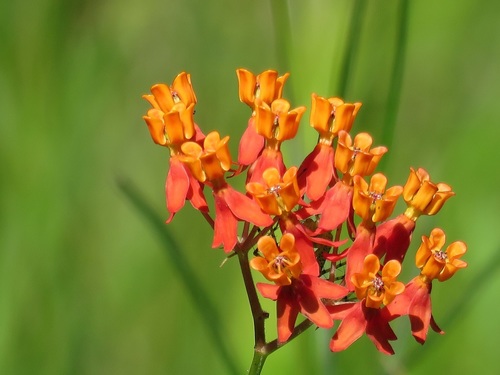
About Asclepias lanceolata Walter
Asclepias lanceolata Walter, commonly called fewflower milkweed, is an upright herbaceous perennial. It reaches a height of 3 to 5 feet. Its leaves are oppositely arranged, lanceolate shaped with an acuminate apex, and can grow up to 10 cm long. The stem branches near the top to produce 1 to 3 umbels, each holding an average of seven red-orange flowers. The common name fewflower milkweed comes from this species having fewer flowers than most other members of the genus Asclepias. This species is completely deciduous in winter and is barely noticeable when not in flower. Asclepias lanceolata occurs on the coastal plains of the Eastern and Southeastern United States, and has been recorded in Alabama, Delaware, Florida, Georgia, Louisiana, Maryland, Mississippi, North Carolina, New Jersey, South Carolina, Tennessee, Texas, and Virginia. It is distributed through most of Florida, but only found in small areas of southeast Texas. More detailed county-level distribution information is available in the USDA's plant profile for this species. A. lanceolata is cultivated for display at the Crosby Arboretum in Picayune, Mississippi. Fewflower milkweed is most often found in fresh and brackish marshes, low glades, and wet pine barrens. It prefers well-drained sandy and loamy soils, but can also survive in poorly drained swampy soils. It grows best at a soil pH between 5 and 7, but tolerates a pH range from 4.5 to 7.5. While it can grow in semi-shaded areas, it prefers full sun. It is adapted to annual precipitation between 500 and 1500 mm, with an optimal annual precipitation range of 600 to 1400 mm. It tolerates temperatures ranging from 8 to 35 degrees Celsius, with an optimal range of 12 to 30 degrees Celsius, and can withstand winter temperatures as low as -25 degrees Celsius. In the wild, it often grows alongside Kosteletzkya virginica, or Salt Marsh Mallow. Young A. lanceolata plants are particularly susceptible to damage from slugs. This species is able to self-fertilize or outbreed, and relies on pollinators to reproduce. It is pollinated by bees, other insects, and Lepidoptera. It acts as a host plant for the larvae of three Danaus butterfly species: monarch (Danaus plexippus), queen (Danaus gilippus), and soldier (Danaus eresimus). It also provides nectar for adult butterflies and other insects, and researchers have found that it is a high-quality nectar resource for its pollinators. All milkweeds are known to be poisonous to humans, so precautions are required if any part of this plant is consumed. While no toxins have been reported in Asclepias lanceolata specifically, most milkweed species contain toxic resinoids, alkaloids, and cardiac glycosides. The flowers, leaves, and young seedpods (3 to 4 cm long; alkalinity and bitterness increase as seedpods grow larger) of this species are considered safe for consumption after proper preparation. Plant parts, especially stems and mature leaves, need to be boiled with three changes of water to remove any potential toxins. Young leaves, young seedpods, and unopened flower buds can be cooked the same way as spinach or broccoli, and can be eaten on their own or added to dishes like soups. Boiling down nectar-containing flower clusters produces a sugary sweetener. The only documented medicinal use of A. lanceolata is for wart treatment. Latex from the plant's stems and leaves is effective for reducing warts, but it must only be used topically and never ingested.