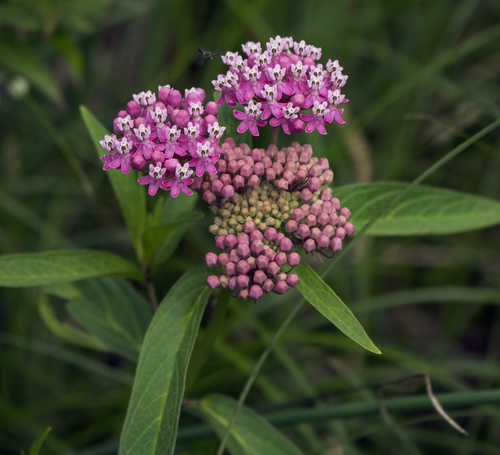
About Asclepias incarnata L.
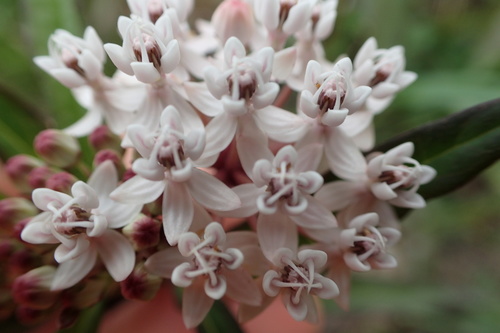
Asclepias incarnata L., commonly called swamp milkweed, is an upright clump-forming plant that reaches 100 to 150 cm (39 to 59 inches) in height, growing from thick, fleshy white roots. Its stems are typically branched, and shoots emerge in late spring, after most other plants have started their yearly growth. Its leaves are arranged oppositely along the stems, measure 7.5 to 15 cm (3 to 6 inches) long and 1 to 4 cm (1/2 to 1+1/2 inches) wide, and are narrow lance-shaped with sharp tapered tips. Swamp milkweed blooms from early to mid-summer, producing small fragrant flowers in shades ranging from pink to mauve, sometimes white; flower color varies from darker purple shades to soft pinkish purple, and a white-flowered form also exists. The actinomorphic flowers have five reflexed petals and an elevated central crown, arranged in rounded umbellate racemes. After blooming, plants produce green follicles around 12 cm (4+3/4 inches) long that split open when ripe. The follicles release flat light or dark brown seeds, each attached to a silver-white silky hair that catches wind for dispersal, a mechanism shared with other milkweed species. A second blooming period can occur from mid- to late summer. After this second bloom, long, relatively thin, upright rounded follicles form that split open from late summer to late fall, again releasing seeds attached to wind-carried silky parachute hairs. Its specialized thickened white roots function well in heavy, wet soils with low oxygen. Swamp milkweed grows naturally in neutral to slightly acidic, nutrient-rich soils that stay wet, ranging from very muddy to average garden moisture, and tolerates full sun or partial shade. It is most commonly found at the margins of flooded plains, lakes, ponds, waterways, marshes, swamps, and other wet areas. It is one of the most effective plants for attracting the monarch butterfly (Danaus plexippus): monarchs feed on its flowers, lay eggs on the plants, and emerging caterpillars feed on its leaves. Breeding monarchs prefer to lay eggs on Asclepias incarnata specifically. Asclepias incarnata is widely cultivated, with a number of cultivars available. It is especially used in butterfly gardens designed to attract butterflies, and its nectar attracts many other insect species too. It is also sold as a fresh cut flower, valued for its long-lasting floral display, and sometimes for its distinctive follicles. The organization Monarch Watch provides information on rearing monarchs and their host plants. Efforts to boost monarch butterfly populations by establishing butterfly gardens and monarch migratory waystations require careful attention to the species' food preferences, population cycles, and the conditions needed to propagate and maintain its food plants. Like some other milkweed species, Asclepias incarnata seeds need a period of cold treatment (cold stratification) before they can germinate. To protect seeds from washing away in heavy rain and from being eaten by birds, seeds can be covered with a light fabric or a 13 mm (0.5 inch) layer of straw mulch. However, mulch acts as an insulator: thicker mulch layers can prevent germination by stopping soil temperatures from rising enough after winter ends, and few seedlings can push through thick mulch. The species is frequently planted in butterfly gardens and Monarch Waystations to help sustain monarch populations. Asclepias incarnata is an early successional plant that usually grows at wetland margins and in seasonally flooded areas. It spreads slowly via seed, does not spread via runners, and tends to disappear as vegetation density increases and habitats dry out. While individual plants can survive for up to 20 years, most live only two to five years in garden settings. The species is not shade-tolerant and is not a strong vegetative competitor.