About Asclepias eriocarpa Benth.
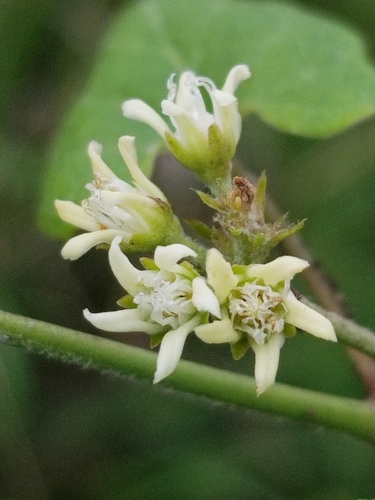
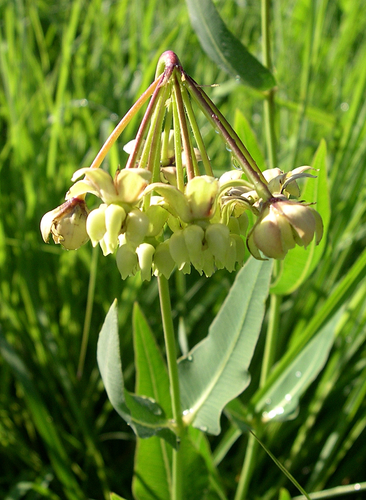
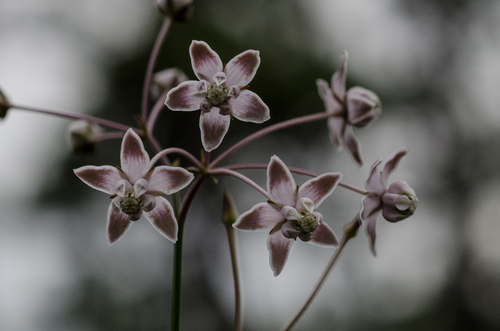
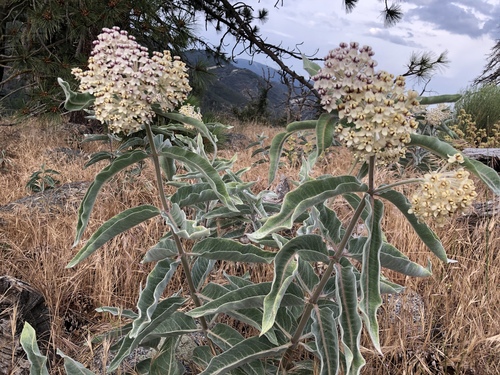
Asclepias eriocarpa is an erect perennial herb, usually covered in a thick layer of white hairs. Its leaves are lance-shaped to oval, rippled, and arranged in opposite pairs or whorls of 3 or 4. The inflorescence forms a large umbel-like cluster of flowers. Each flower is white to cream, usually tinted with bright pink. It has a central set of rounded hoods, and a corolla that is reflexed against the stalk. The fruit is a large, woolly follicle. Flowers bloom from May to October. Asclepias eriocarpa is native to California, adjacent parts of Nevada, and Baja California. It grows across many habitat types including rocky hillsides, woods, and deserts, and is particularly common in dry areas. Ecologically, this species is a specific food and habitat plant for monarch butterflies. It is classified as one of the most poisonous milkweeds. A July/August 2015 Natural History publication calls it the most poisonous milkweed, but most sources rank its toxicity below that of Asclepias lancifolia, which is now known as Asclepias perennis. Several California Indigenous groups, including the Ohlone and Luiseño, used this plant as a source of fiber and for medicine. In the Konkow language, the Concow tribe calls this plant bō'-kō.