About Asclepias curassavica L.
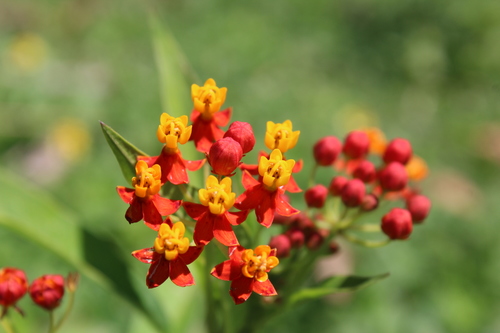
Asclepias curassavica L. is typically an evergreen perennial subshrub, growing up to 1 meter (3.3 feet) tall with pale gray stems. Its leaves are arranged oppositely along the stems, shaped as lanceolate or oblong-lanceolate, and end in acuminate or acute tips. Like other species in the Asclepias genus, it produces milky sap. Its flowers grow in cymes, each holding 10 to 20 individual flowers, with purple or red corollas and yellow or orange corona lobes. This species flowers nearly year-round. Its fruits are fusiform follicles 5 to 10 centimeters (2.0 to 3.9 inches) long. Each follicle contains tan to brown, ovate seeds 6 to 7 millimeters (0.24 to 0.28 inches) long. These flat seeds have silky hairs that let them disperse via air currents once the pod-like follicles split open. NatureServe classifies Asclepias curassavica as a widespread species native to a range extending from southern North America, through Central America, into South America. It has been introduced to the U.S. states of California, Florida, Hawaii, Louisiana, Tennessee, and Texas, as well as the U.S. unincorporated territories of Puerto Rico and the United States Virgin Islands. It has also been introduced and naturalized across 15 Chinese provinces (Anhui, Fujian, Guangdong, Guangxi, Guizhou, Hainan, Hubei, Hunan, Jiangsu, Jiangxi, Qinghai, Sichuan, Xizang, Yunnan, and Zhejiang) and Taiwan. It was introduced to Australia before 1869, and is now widespread in parts of Queensland. At the Meteor Downs South Project near Rolleston, Queensland, it is classified as an exotic plant and a weed. In ecology, Asclepias curassavica attracts butterflies of the Danainae subfamily, including queen and monarch butterflies. It is cultivated as an ornamental garden plant and a food source for certain butterflies. Multiple cultivars exist with altered flower colors and shorter growth habits; some cultivars have bright red, yellow, or orange flowers. It is sometimes also grown as a cut flower. When stems or leaves are broken, poisonous milky sap leaks out, which can cause eye injury. Cultivation of Asclepias curassavica in gardens outside its native tropical range may harm monarch butterfly migration patterns. Public concern over rapidly declining monarch populations has increased demand and commercial availability of milkweed at U.S. nurseries, but outcomes of widespread tropical milkweed planting have been mixed. While tropical milkweed can successfully support monarch larvae, its year-round perennial growth disrupts monarch migration patterns and may cause other physiological negative effects. Planting tropical milkweed in gardens has notably disrupted monarch migrations in California, Texas, Florida, and South Carolina. Unlike milkweed species native to these areas, tropical milkweed does not go dormant in winter, which leads to the formation of non-migratory monarch groups. Because of this, planting Asclepias curassavica in nonnative regions remains controversial and widely criticized. As an alternative, native milkweed species are recommended for butterfly gardens, such as showy milkweed, narrowleaf milkweed, and desert milkweed for California.