About Asclepias cordifolia (Benth.) Jeps.
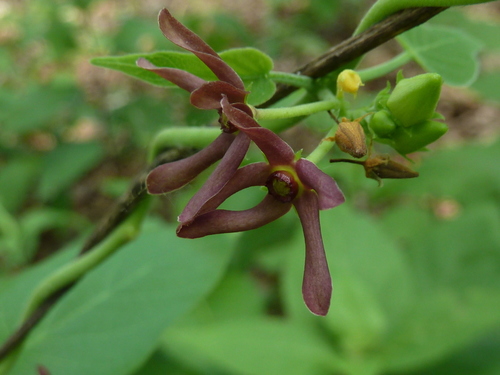
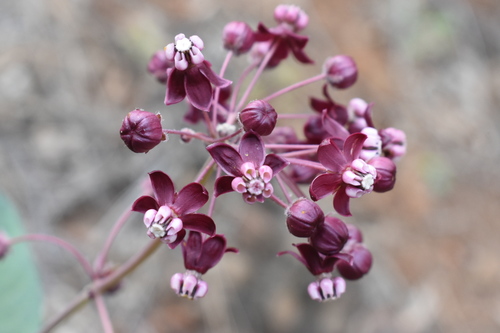
Heart-leaf milkweed, scientifically named Asclepias cordifolia (Benth.) Jeps., is a perennial plant that reaches 0.3 to 0.6 meters (1 to 2 feet) in height. It produces dark red-purple flowers, whose hoods sit slightly elevated above the base of the corolla. Its flower structure is unusual: five stamens are fused into a column, with five circular attachments called 'hoods', and an anther head surrounds the large stigma at the flower's center. The fruit is a follicle that holds many flat seeds, each with silky hairs that allow easy wind dispersal. The plant's large opposite leaves are cordate, meaning heart-shaped. It grows in open or shaded woodland, often on rocky slopes and in mixed coniferous forest, and blooms from May to July. Like other milkweeds, it gets its common name from the milky sap that oozes from its stem. In ecological terms, monarch butterfly caterpillars are commonly found on all milkweeds, including heart-leaf milkweed. Alkaloids ingested from the plant by the caterpillar are retained even after it metamorphoses into a butterfly, making the butterfly unpalatable to predators. Historically, the Miwok people gathered heart-leaf milkweed in summer and dried it, or collected it already dry in fall. Dry stems were combed with a willow loop to remove the fiber just under the thin outer skin. The fiber was wound into balls for storage and later processing, and cordage (rope and string) was made entirely by hand with no tools. The Yokuts (or Mariposa) Native American group of northern and central California also used Asclepias fiber to make string or rope. A single Miwok feather skirt or cape required approximately 100 feet of cordage, which needed around 500 plant stalks. A 40-foot-long deer net needed about 7,000 feet of cordage, requiring harvest of around 35,000 plant stalks. Miwok people burned milkweed stalks in fall to remove dead growth, stimulate the next year's growth, and encourage increased flower and seed production. Most cordage made from this plant was two-ply, though the Field Museum holds some examples of three- and four-ply Miwok cordage. Heart-leaf milkweed was also used as a contraceptive and a snakebite remedy. Without proper preparation, it can cause vomiting at low doses and death at higher doses, due to a mix of cardenolides in its sap. It was once classified as a noxious weed because of reported negative effects on livestock.