About Asclepias cinerea Walter
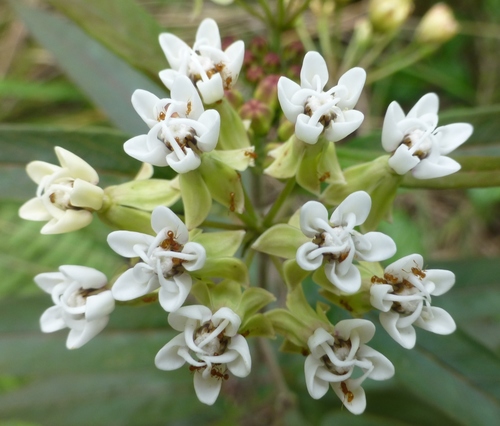
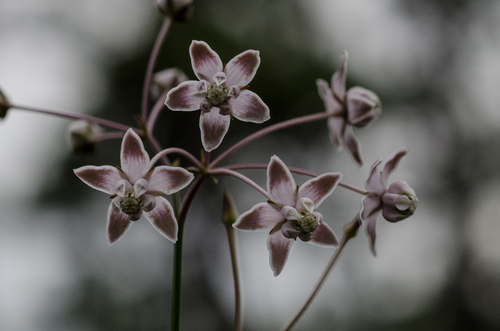
Asclepias cinerea Walter is a perennial herb with a grass-like appearance. It has a thin, smooth stem that grows up to 2 feet (0.61 meters) tall. Its leaves are 2 to 4 inches (51 to 102 millimeters) long, linear, narrow, glabrous, and arranged oppositely along the stem. Its flowers are sparse and loosely grouped into axillary or terminal umbels. Each flower has a five-lobed corolla (petals) that is either flat or reflexed, and can be colored ashy-gray, pale violet, or pale rose. The fruit of Asclepias cinerea is a smooth, slender follicle that measures 3 to 4 inches (76 to 102 millimeters) long. When the follicle reaches maturity, it splits open to release its seeds. Each seed has white fluffy hairs called a pappus attached to it, which helps the seed disperse via wind.
This species occurs on the Southeastern Coastal Plain of the United States, ranging from eastern South Carolina south to the Florida panhandle, and west to southern Mississippi. It was historically found in North Carolina, but is now extirpated there. Its native habitats are pine-wiregrass savannas, flatwoods, sandhills, bogs, and pine-scrub oak ridges. It can grow across a range of light levels, from full sun to full shade, and grows in a variety of sandy soils, including loamy sand, boggy soils, sandy peat, and Penney and Ridgewood soil types.
Asclepias cinerea has been recorded flowering from spring into summer, and fruiting throughout the summer months. Like other milkweed species, A. cinerea is a host plant for monarch butterflies (Danaus plexippus) and queen butterflies (Danaus gilippus). It also serves as an important nectar source for other butterflies, bees, wasps, and beetles.