About Asclepias angustifolia Schweig.
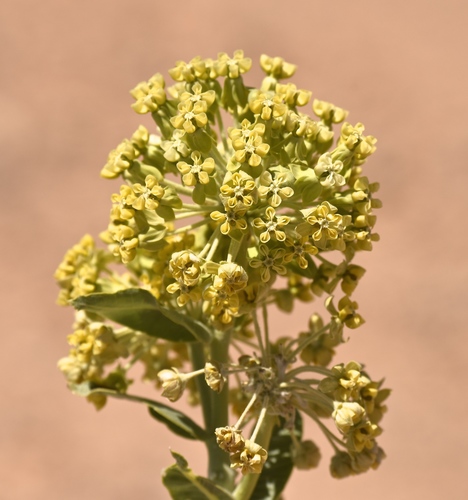
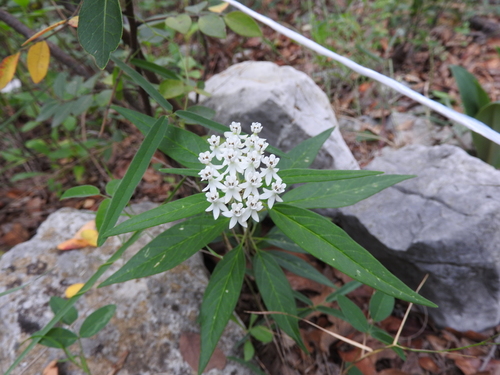
Asclepias angustifolia Schweig., commonly called Arizona milkweed, is an herbaceous perennial with a taproot, growing up to 28 inches (71 cm) tall. Multiple stems can grow from a single crown. Its leaves are opposite, linear, glabrous, and borne on short petioles; they are 4–12 cm (1.6–4.7 in) long and 2–11 mm (0.079–0.433 in) wide. Its inflorescences are erect umbels 2–4 cm (0.79–1.57 in) long, with one peduncle per node and at least one peduncle per stem, usually produced near the top of the stem. Its flowers are 3 mm (0.12 in) in both diameter and length, with 5 mm (0.20 in) pedicels; they have reflexed corollas and horns that extend beyond the hoods, and their color ranges from whitish to pink. Its seed pods are slender and upright, 3.5–9 cm (1.4–3.5 in) long, and hold anywhere from a few to many seeds. Seeds are approximately 4 mm long, and attached to a white silky coma around 4 mm (0.16 in) long. This species grows at higher elevations between roughly 1,050 to 2,100 metres (3,440 to 6,890 ft). In the United States, it is only found in Pima, Santa Cruz, and Cochise counties in Arizona, and is considered rare there, restricted to the borderlands. It most often grows in dry rocky native soils, and its habitats include riparian woodlands, floodplain meadows, cienega edges, canyons, and arroyo bottoms. Arizona milkweed is a known host plant for the Monarch Butterfly, and acts as a feeding and development site for Monarch larvae, making it an important species for conservation efforts to prevent the butterfly’s extinction. It has been observed being pollinated by small carpenter bees of the genus Ceratina. Like all Asclepias species, pollination of Asclepias angustifolia happens mechanically via insects. Arizona milkweed is available commercially both as seed and as propagated plants. Seed germinates readily, and mature flowering plants can be produced in as little as three months. It can be grown successfully in containers as small as one quart. This species tolerates both excess watering and extended periods without watering, and substrate type has not been observed to be an important factor for its growth. It grows well in substrates ranging from organic-rich soils to sandy loam. It is cold hardy to temperatures as low as −12 °C (10 °F).