About Asclepias albicans S.Watson
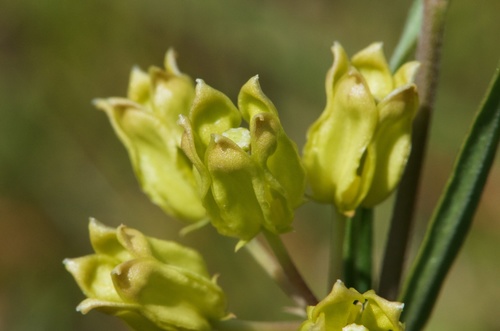
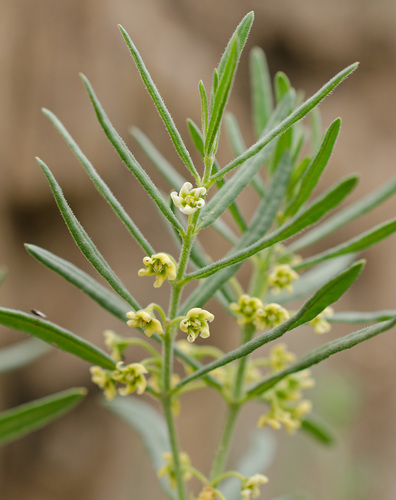
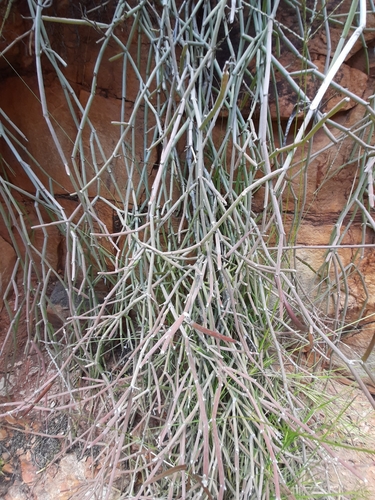
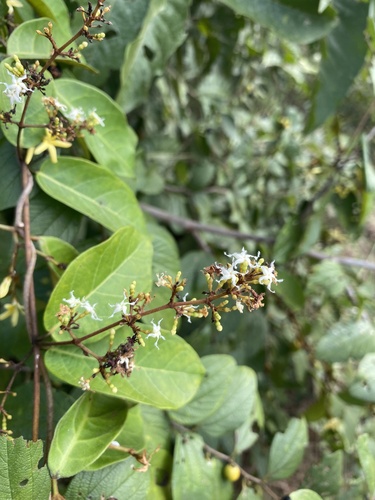
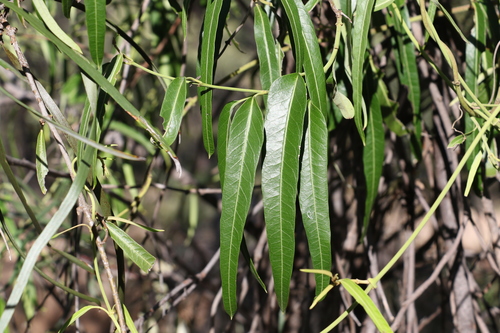
Asclepias albicans S.Watson, commonly called whitestem milkweed or wax milkweed, is a milkweed species native to the Mojave and Sonoran Deserts of California, Arizona, and Baja California. It is a spindly, erect shrub that typically grows 1 to 3 meters (3 ½ to 10 feet) tall, and has been recorded to reach nearly 4 meters (13 feet) in height. Its sticklike branches are mostly bare; younger branches are coated in waxy residue and a thin layer of woolly hairs. This species produces ephemeral leaves, which grow in whorls of three on the lower branches and fall off after a short period. Leaves are linear in shape, reaching up to 3 centimeters (1 ¼ inches) long. Inflorescences are umbels roughly 5 cm (2 in) wide, growing at the tips of the long branches and sprouting from the sides of branches at nodes. Each inflorescence holds many purple-tinted greenish flowers, each approximately 1.5 cm (½ in) wide. Flowers have a central cluster of bulbous hoods, with reflexed corollas that curve back against the flower stalk. Within its native range, Asclepias albicans is an evergreen perennial that usually blooms year-round. Its fruit is a large, long, thick follicle that dangles from branch nodes. This plant grows in dry, rocky desert locations. It acts as a larval host plant for both the monarch butterfly and the queen butterfly. A closely similar species, A. subulata, occurs in the same general regions.