About Asaphodes chlamydota (Meyrick, 1883)
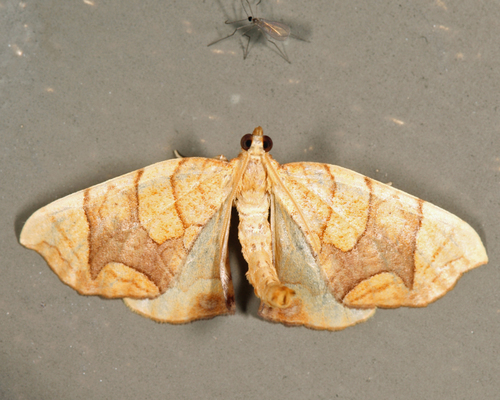
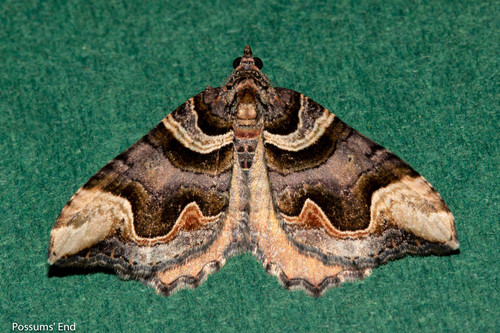
Asaphodes chlamydota was first described by Edward Meyrick in 1883, and George Hudson later provided the following species description. The wingspan of this moth is approximately 1 and 1/4 inches. The forewings are pale ochreous, marked with two broad, dark purplish-brown bands. The first band sits at the base of the wing; it is slightly paler near the body, strongly curves outward toward the termen, and is followed by several very fine pale brown transverse lines. The second broad band is located near the center of the wing. Its inner edge curves inward, and its outer edge has two rounded projections: one very large projection near the middle of the wing, and a much smaller one near the dorsum. The central portion of this band is considerably paler than its edges, and the two projections of the central band are bordered with bright red. The upper section of the termen is ochreous with several faint brown marks, while the lower section is dull grey. The hindwings are dark ochreous with a few obscure purplish-grey markings; the termen of the hindwing projects slightly near the middle and is rather jagged. This is a distinctive species that is easily recognized. There are slight differences in colouration between specimens from the North Island and South Island of New Zealand. North Island individuals have black markings on a light orange hindwing base, while South Island individuals lack these black hindwing markings. Asaphodes chlamydota is endemic to New Zealand, and can be found in both the North and South Islands. Meyrick recorded the species as present in Wellington, Christchurch, and Akaroa, and Hudson noted it occurs in the Wellington Botanic Garden. Specimens have also been collected in mid Canterbury, and the species has been found in the Dansey ecological district in Otago. This species inhabits native forest and shrubland, and has been recorded at altitudes below 500 m. The larvae of Asaphodes chlamydota feed on plants in the genus Clematis, including Clematis afoliata and Clematis marata. Adult Asaphodes chlamydota have intermediate flight ability, and remain active during light breezes.