About Asaphodes beata (Butler, 1877)
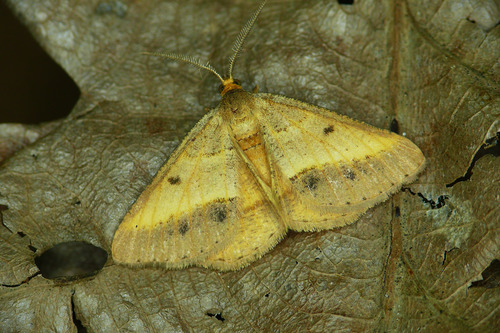
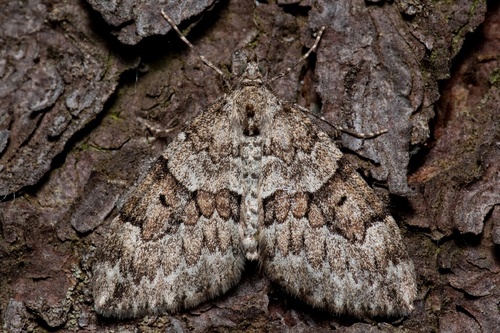
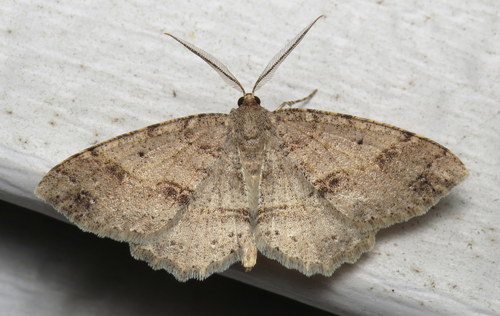
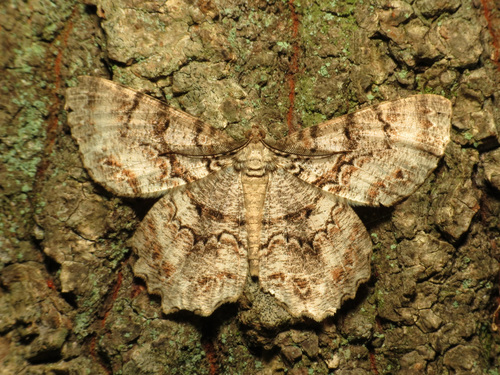
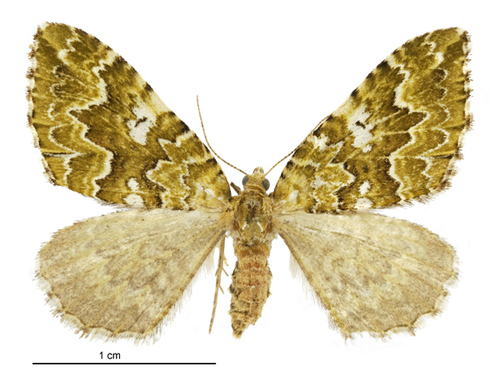
Asaphodes beata is a species of moth first described by Butler in 1877. Hudson described the egg of this moth as approximately one fiftieth of an inch long, oval, considerably flattened, with a distinct concavity on each side. The egg is green, highly polished, and marked with numerous very shallow hexagonal depressions. Its colour changes to greyish-green about two days before the larva hatches. He described the larvae as orange-brown when they first emerge, becoming greenish-brown shortly after. Full-grown larvae are dark brown on the upper side and pale brown on the underside, with the two colours sharply separated along the sides by a broken white line. A series of V-shaped markings runs along the back, each marking enclosing a paler area. Several fine black wavy lines cross the darker areas of the larva, and a dark mark edged with black on its lower edge sits on each segment just above the ventral surface. The larva constructs a frail cocoon on the ground, where it pupates. Butler's original description of adult A. beata notes that the upper side of the wings is very similar in pattern to the preceding species discussed in his work, but A. beata is much smaller. On the forewings, all markings are olive-green rather than bronzy brown; the hindwings are white instead of yellow, with a pale pinky brown outer border. The thorax is olive-green, and the abdomen is testaceous. On the underside of the forewings, the basal area extending to the end of the dentated central band visible on the upper surface is madder-brown. The costa is testaceous, tinted with olivaceous, and crossed by ferruginous bars. The disk is whitey-brown; the apex and outer border are shining testaceous, almost golden. A submarginal series of white dots is present, and the silvery white fringe is marked with black spots. The underside of the secondaries is pale testaceous, increasing in intensity towards the outer border, which is golden. It is crossed by parallel crenate olivaceous lines, three of which form a central band, relieved externally by white lunules. The disk is crossed by paler olivaceous lines, followed by a submarginal series of white lunules. The body on the underside is testaceous. The wingspan of this species is 1 inch. This species can be distinguished from its close relative A. adonis by the colour of its hindwings. Hudson notes that the white markings on the forewings of this moth are variable. It is also very similar in appearance to A. philpotti, and because of this similarity, A. philpotti was previously included within the species concept of A. beata. A. beata can be told apart from A. philpotti by the black marks inside the white discal spots on its forewings, which A. philpotti does not have. A. philpotti is also distributed in more southerly locations. A. beata is endemic to New Zealand. This relatively common species can be found in native forest throughout the country, and it frequents forest clearings. It can also be found in coastal habitats. This species inhabits native forest and scrub. Hudson stated that the larvae of this species feed on watercress. Larvae have also been found feeding on plants growing on the forest floor, including native herb plants in the genera Epilobium, Cardamine, and Stellaria. Adult A. beata are reported to be attracted to the flowers of white rātā.