About Arundinaria tecta (Walter) Muhl.
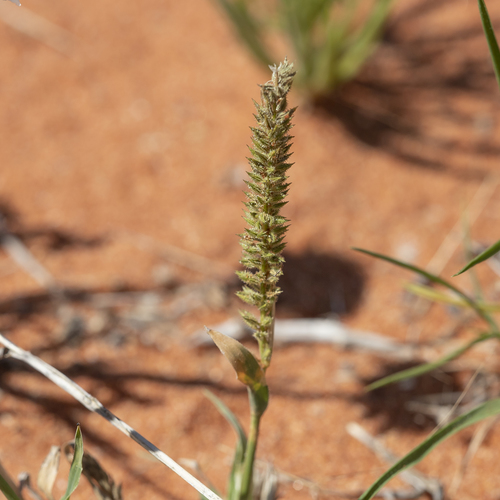
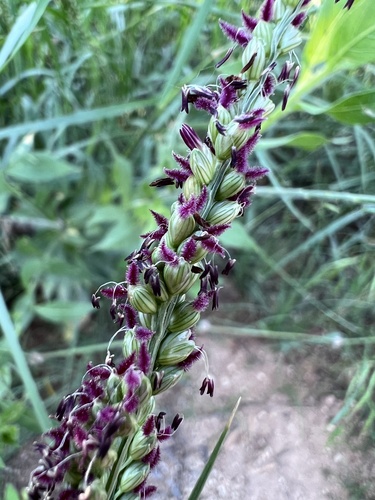
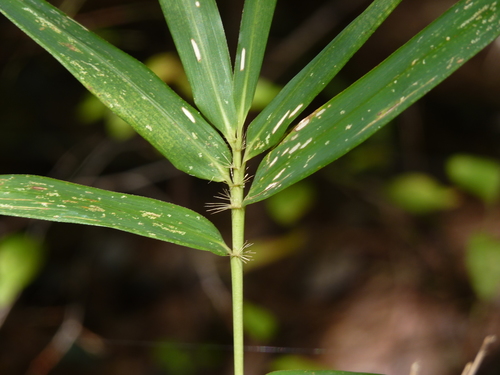
Arundinaria tecta (Walter) Muhl. is a low, slender bamboo that branches in its upper half, reaching a height of 0.6–4 m (2 ft 0 in – 13 ft 1 in). This species has long primary branches, usually longer than 50 centimetres (20 in). Its leaves measure 8–20 cm (3.1–7.9 in) long and 0.8–3 cm (0.31–1.18 in) wide, tapering toward the base, and both leaf surfaces are densely covered in fine hairs. The midculm leaves of A. tecta are longer than the internodes they are associated with. Panicles grow on shoots that emerge directly from the plant's rhizomes, which have continuous air canals. Each panicle holds a small number of clustered spikelets on slender branches; these branches have loose sheaths with minute leaves. The spikelets are 2.5–5 cm (0.98–1.97 in) long and bear five to ten flowers. The plant flowers from March to June. Arundinaria tecta is mostly restricted to the Coastal Plains of the Southeastern United States, where it grows in wetlands, bogs, swamps, and sandy stream margins. It commonly occurs in low-lying, moist areas including live oak woods and non-alluvial swamps, but it can also be found in the Blue Ridge and Piedmont regions of the Southeast. Large populations of this species form canebrakes, which are classified as critically endangered ecosystems. The phenology and reproductive cycles of Arundinaria tecta are largely unstudied, and existing information on the topic is often conflicting. Some sources suggest the species flowers synchronously after intervals ranging from 3 to 50 years, after which entire stands die off. Other sources have found that its flowering is unpredictable and follows irregular cycles. Its full life cycle is usually at least several decades long. Arundinaria tecta is thought to flower more frequently than its close relative A. gigantia. Flowering generally occurs from February to June. Reportedly, seeds have very low viability rates, with only one out of 10,000 florets producing a viable seed. There is little consensus on flowering cycles across Arundinaria species, but all species in the genus are assumed to be wind-pollinated. This low seed viability and long life cycle may be one reason that restoration of large canebrakes is difficult and requires long timelines. Squirrels, quail, turkey, and humans all act as seed predators of Arundinaria tecta.