About Arundinaria appalachiana Triplett, Weakley & L.G.Clark
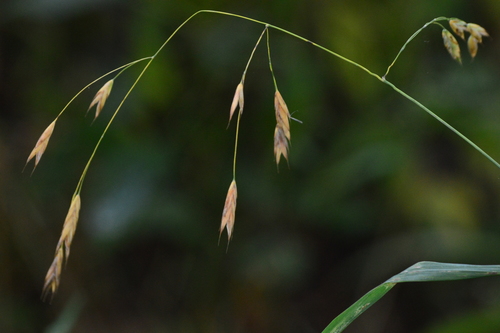
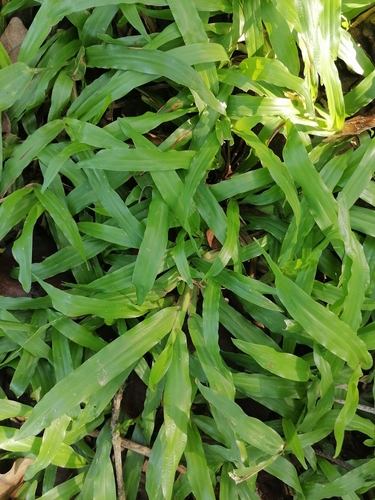
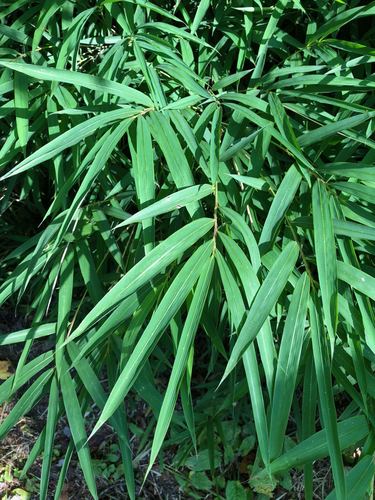
Arundinaria appalachiana, commonly known as hill cane, is the smallest species in its genus. Its above-ground stems, called culms, usually reach heights of 0.5 to 1 metre (1.6 to 3.3 ft), and may occasionally grow as tall as 1.8 m (5.9 ft). The culms are also quite thin, with diameters between 0.2 to 0.6 centimetres (0.079 to 0.236 in). Like all bamboos, A. appalachiana grows its culms from underground rhizomes. For hill cane, these rhizomes are leptomorph, which means they spread horizontally, but they typically do not travel very far before turning upward to grow a new culm. Rhizomes vary somewhat in structure: they sometimes have hollow centres and air canals. The culms have terete internodes, which are smooth, cylindrical, and slightly tapering. Culm sheaths are usually persistent, meaning they are not shed from the culm, but they may fall off late in winter. These sheaths measure 5.5 to 11 cm (2.2 to 4.3 in) in length, and have very short oral setae, which are bristles growing where the sheath meets the leaf blade. The setae range from 1 to 4.6 millimetres (0.039 to 0.181 in) long. The small culm blades that grow at the apex of each sheath are much shorter than the plant’s foliage leaves, and measure 0.8 to 1.4 cm (0.31 to 0.55 in) in length. In the genus Arundinaria, every new culm is topped with a fan-shaped cluster of leaves called a top knot. In A. appalachiana, each top knot contains 6 to 12 leaves that are 9 to 22.5 cm (3.5 to 8.9 in) long by 1.4 to 2.8 cm (0.55 to 1.10 in) wide. These leaves can be linear (long and narrow), lanceolate (lance-shaped, slightly wider toward the middle), or ovate-lanceolate (intermediate between egg-shaped and lance-shaped). The plant’s primary branches are erect and terete, and are typically no longer than 35 cm (14 in). The bases of primary branches hold between 2 and 5 compressed internodes, and secondary branching does not develop at these basal sections. Foliage leaves are deciduous, and their blades are typically 5 to 20 cm (2.0 to 7.9 in) long by 0.8 to 2 cm (0.31 to 0.79 in) wide. The leaf blades have rounded bases and a chartaceous, paper-like texture. The abaxial surfaces (undersides of the blades) have faint cross veining, and are either pilose (covered in fine, soft hairs) or glabrous (hairless). The adaxial surfaces (upper sides of the blades) are always pilose. The ligules, thin outgrowths at the junction of the leaf blade and leaf sheath, can be either glabrous or ciliate (fringed with hairs), and either lacerate (jagged) or fimbriate (fringed). The plant’s spikelets, the grass inflorescences that hold its flowers, measure 3 to 5.5 cm (1.2 to 2.2 in) in length and are typically a subtle reddish-purple colour. Each spikelet contains 5 to 8 florets. Flowering in Arundinaria appalachiana is currently very poorly understood. When Triplett, Weakley and Clark originally described the species, they encountered only one flowering specimen. While flowering is rare in most bamboos, this finding suggests flowering may be even less common in hill cane. Arundinaria appalachiana is native to the southern Appalachian Mountains and upper Piedmont of the southeastern United States, where it occurs in western North and South Carolina, southeastern Tennessee, northern Georgia and northeastern Alabama. It grows at elevations ranging from 300 to 800 metres, and may occasionally be found as high as 1065 metres. Its most common habitat is dry to somewhat mesic upland slopes, but it can less commonly be found in somewhat moister soils near spring seeps or along small streams.