About Arundina graminifolia (D.Don) Hochr.
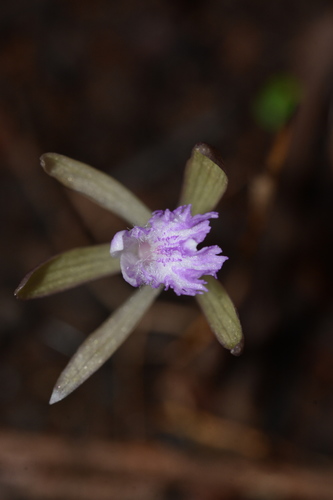
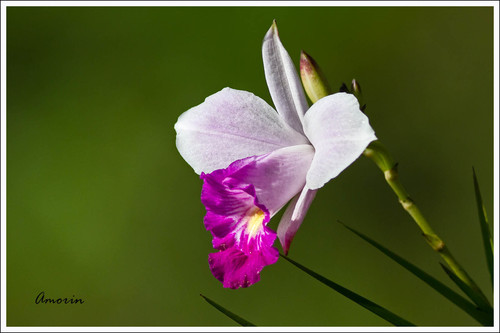
Arundina graminifolia is a terrestrial, perennial orchid that forms large clumps, with reedy stems that grow between 70 cm and 2 m in height. Its leaves are linear, plaited, and oblong lanceolate, measuring 9 to 19 cm long and 0.8 to 1.5 cm wide, with an acuminate apex. The species also has amplexicaul, or stem-clasping, sheathing stipules. This orchid blooms during summer and autumn, producing open clusters of showy terminal flowers, with a maximum of ten flowers per cluster. Flowers bloom successively on terminal racemes that are 7 to 16 cm long. Each flower is 5 to 8 cm in diameter, with rosy lilac coloring overall, a white disc, and a purple lip. Broadly triangular bracts surround the main stalk of the flower cluster. Occasional fertilized seed pods hold minute, powdery seeds, and small plants often develop near the ends of the stems after flowering; these small plants likely help with propagation if they are able to reach the soil. A. graminifolia depends on pollinators, and requires pollination to produce seed capsules. At one point, only 200 naturally growing individuals of this species were recorded in Singapore, leaving the species close to extinction. This decline was caused by destruction of the orchid's natural habitat, which includes rainforests and mangrove forests. Through replanting efforts carried out by NParks, the species is now listed as a common cultivated plant in Singapore. In Malaysia, A. graminifolia is commonly called tapah, and can be found growing in secondary forests and at forest fringes. It is very common in road cuts and other disturbed areas in full sun in Sarawak, where it is often the most common flowering plant seen along roadsides. A. graminifolia shows invasive behavior in the tropical areas of Hawaii, Mauritius, and Puerto Rico.